
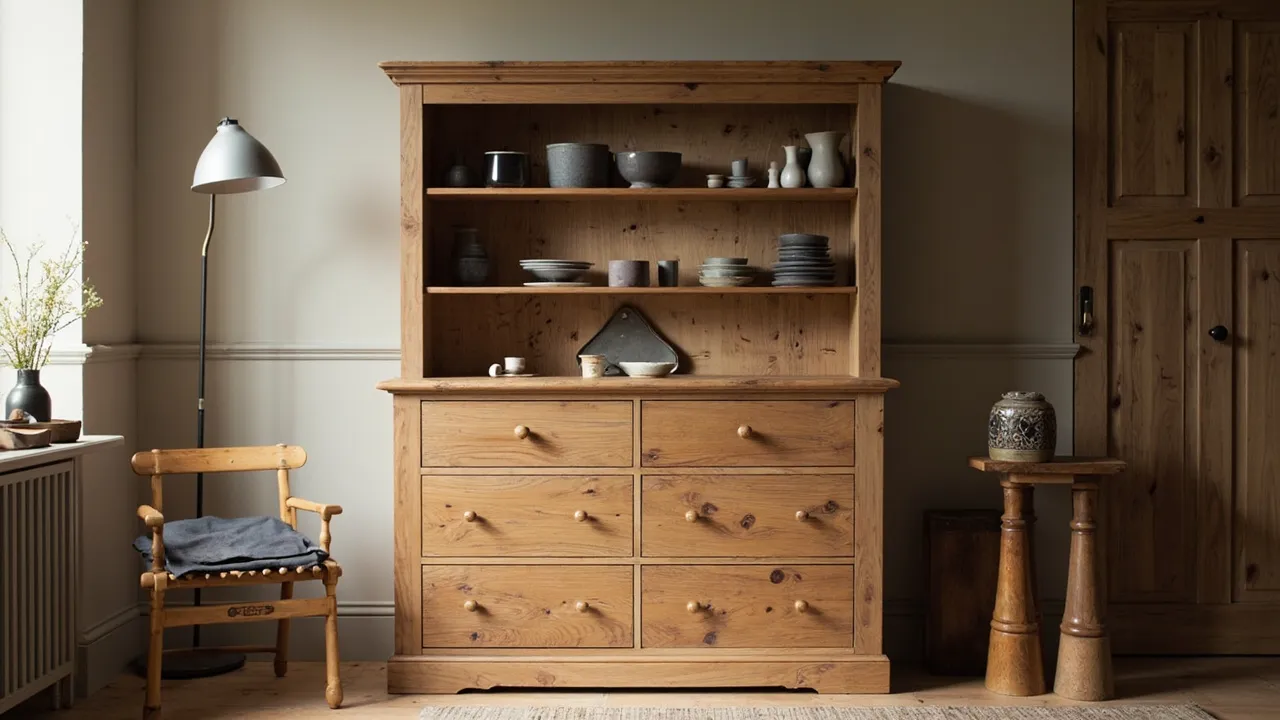
A Welsh dresser is a wooden piece with drawers and cupboards below and open shelves above, made to store and show off crockery. Choose oak, pine or a painted finish, and decide whether to restore an old one or have a new dresser made.
A dresser suits Yorkshire farmhouses and mill cottages, and it still suits a stone-built kitchen better than almost anything else. We make them by hand in our workshop and showroom at Crossley Mills in Honley, and we restore old ones too. This guide covers where the dresser came from, what each part is called, and how to choose between old and new.
Key takeaways
- It pairs a base of drawers and cupboards with open shelves on top, built to store and display crockery.
- It began as a working kitchen piece and grew into a way to show off the best plates.
- Oak, pine and painted finishes all work; the right one depends on your room and how you live.
- We can't value antiques. If you think an old dresser is worth something, ask an antiques specialist before you strip or alter it.
What is a Welsh dresser?
Wikipedia describes a Welsh dresser as "a piece of wooden furniture consisting of drawers and cupboards in the lower part, with shelves and perhaps a sideboard on top". The same entry notes it is sometimes called a kitchen dresser, pewter cupboard or china hutch, and that it was traditionally used "to store and display crockery, silverware and pewter-ware".
In practice, it is two pieces of furniture in one: a hard-working cupboard base with a flat top you can use as a serving surface, and a set of open shelves above that turns everyday plates into part of the room. That mix of storage and display is why the dresser still earns its place in a modern kitchen.
Where did the dresser come from?
According to the same Wikipedia entry, the dresser was originally a kitchen piece "where meat and other food was dressed or prepared", while finished food went to the sideboard in the dining room. Over time it took on a second job as "a means of displaying the best crockery in a farmhouse", and from there it moved into dining rooms as well.
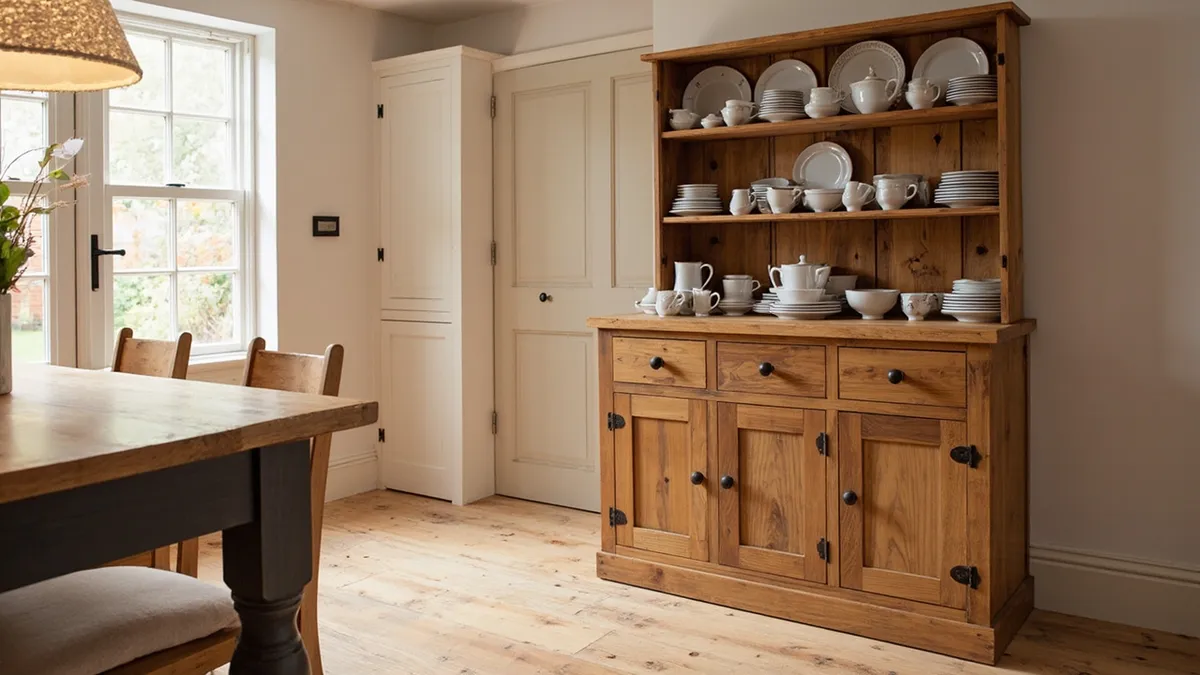
The entry also says dressers "could be modified to suit local needs", giving the example of a tin-lined "porridge drawer" in some Scottish Highland dressers. In Wales, it notes that 19th-century ceramics developed to fill the plate racks of these dressers, and that local customs around caring for and displaying a dresser became part of the culture of North Wales in particular.
We wouldn't claim more than that about regional styles. Plenty of dressers were made by village joiners to suit one house and one family, so two old pieces from the same county can look quite different.
What are the parts of a dresser called?
Names vary from maker to maker, but these are the terms we use in the workshop when we draw up a dresser with a customer.
| Part | What it is | What to decide |
|---|---|---|
| Cornice | The moulded top that finishes the shelves | Plain or moulded profile, and whether it should line up with kitchen cabinetry |
| Plate rack (shelves) | The open upper section | Number of shelves, plate grooves or rails, and any small spice drawers or cupboards |
| Backboards | Boards behind the shelves | Tongue and groove boarding, and whether it is painted or left in the timber |
| Worktop | The flat surface on top of the base | Thickness, edge detail and finish |
| Drawers | A row of drawers under the worktop | How many, how deep, and how the drawers are jointed |
| Cupboards | Doors in the lower part | Panelled or plain doors, shelves inside |
| Plinth or feet | What the base stands on | Solid plinth for uneven stone floors, or turned or bracket feet |
A good base is mostly about the drawers. We cut drawer joints by hand, and our post on whether dovetail drawers are worth it explains why that matters on a piece you'll open every day.
What is the difference between a Welsh and French dresser?
There isn't a fixed rulebook. "Welsh dresser" is the familiar British name for the shelves-over-cupboards form described above. "French dresser" is used more loosely, and we know of no fixed definition. In our experience, people often use it for country-style display cabinets, sometimes painted and sometimes with glazed doors on the top half rather than open shelves.
When people ask us about the difference between Welsh and French dresser styles, the useful answer is to stop worrying about the label and look at three things: open shelves or glazed doors, natural timber or paint, and plain or decorative mouldings. Tell us which of those you like and we can draw a dresser that suits your room, whatever it ends up being called.
Oak, pine or painted: which Welsh dresser suits your home?
Oak
An oak Welsh dresser is heavy, hard-wearing and darkens gently with age. It sits well in a stone farmhouse and pairs naturally with an oak table; our oak dining table guide covers choosing one to match.
Pine
A pine Welsh dresser is lighter in colour and weight and has the relaxed look many people picture in a cottage kitchen. Reclaimed pine adds the character of old timber, and we keep a limited stock of reclaimed timbers.
Painted
A painted Welsh dresser can match your kitchen exactly. We have over 25 years of hand-painting experience, can paint in any colour and offer a colour-matching service. Many people choose a painted base with a natural timber worktop so the surface that takes the knocks can be re-oiled rather than repainted.
Are Welsh dressers worth anything?
Some old dressers are valuable and many are simply useful. We're cabinet makers, not valuers, so we never put a figure on an antique. If you think yours might be old or unusual, ask an antiques specialist for an opinion before you do anything to it.
That matters most before stripping. Original paint or an old finish can be part of what makes a piece interesting, and once it is gone it is gone. If a specialist tells you it is a working piece of furniture rather than a collector's item, restoration is a sensible way to give it another long life.
How do you date an old dresser?
Dating furniture properly is a job for an antiques specialist, and we'd always point you to one. What we can tell you from the workshop is what we look at when an old dresser comes in for restoration:
- How the drawers are jointed and whether the joints look hand-cut or machine-cut.
- Saw and plane marks on the backs and undersides, where nobody was meant to look.
- Whether the top and base were made together or married up later.
- Replacement parts, such as newer backboards, feet or handles.
- Layers of paint and wear in the places hands and feet touch most.
Those clues tell us how the piece was built and repaired. They don't give a date or a value on their own.
Should you restore an old dresser or have a new one made?
Both are good choices. An old dresser brings history; a new one fits your wall, your ceiling height and your crockery. Here is how we'd weigh it up in the workshop:
- Restore if the piece is sound, fits the space and means something to you. Our paint stripping and restoration service can take it back to bare wood, and the guide to stripping paint from wood explains the options.
- Make new if the old one is too tall for a cottage ceiling, too wide for the alcove, or you want it to line up with handmade kitchen cabinetry.
- Combine by keeping an old base and making a new plate rack to suit it, or the other way round.
Our rule of thumb from the workshop: measure the wall, the ceiling and the doorways before falling for a dresser. Old Yorkshire houses have narrow stairs and low beams, and a dresser that can't get through the door is no use to anyone. When we make one, we build the top and base as separate pieces so they can be carried in and assembled in the room. We join the carcass with traditional joints, such as mortise and tenon, and set the base on a plinth or feet that can be scribed to an uneven stone floor.
What should you bring to talk about a dresser?
To make the most of a free consultation, bring:
- The width of the wall, the ceiling height and the width of any doors and stairs on the way in.
- Photos of the room, including floor and skirting.
- A rough count of the plates, bowls and jugs you want on display.
- Any pictures of dressers you like, old or new.
- If you're thinking of restoration, photos of the old dresser, including the back and drawers.
You can see more of our handmade dressers, cabinets and bookcases before you visit.
A handmade Welsh dresser from our Yorkshire workshop
At Oak & Pine by Design, Daniel Fitzpatrick leads every commission himself, from a free consultation through design to installation. Book a showroom visit at Crossley Mills, Honley (by appointment) to see timber samples and finishes, and you're welcome to visit and see your piece being made. We work across Yorkshire, from Holmfirth to the wider county.
Call 01484 666 333, email info@handmadekitchensyorkshire.co.uk or use our contact page. Browse our bespoke dressers and cabinets for ideas.
Frequently asked questions
Why is it called a Welsh dresser?
Our source doesn't explain the name itself. Wikipedia does say that in the 19th century, ceramics developed to fill the plate racks of Welsh dressers, and that customs around caring for and displaying a dresser became important in North Wales culture. The same form is also called a kitchen dresser, pewter cupboard or china hutch.
Can you make a dresser to match my kitchen?
Yes. We design and make dressers by hand in our Honley workshop, so the timber, mouldings, door style and paint colour can match your kitchen cabinetry. We can colour-match a painted finish, and we'll draw it to fit your wall, ceiling height and the way into the room.
Will you strip and restore my old dresser?
We offer paint stripping and restoration, and old dressers are just the kind of piece we work on. If there's any chance it is a valuable antique, get an antiques specialist's opinion first, because stripping removes original finishes that can't be put back. Send us photos and we'll talk it through.
Is oak or pine better for a dresser?
Neither is better in every home. Oak is harder and heavier and suits a darker, traditional room. Pine is lighter and warmer, and reclaimed pine brings old character. Both can be painted. Come and see samples in our showroom and pick the one that suits your house.