
Quick answer: are dovetail drawers worth it
Yes, dovetail drawers are worth it in the drawers you hammer on daily, especially deep pan drawers and cutlery drawers. For a linen or occasional drawer, a box built with a simpler joint performs fine if the timber, base and runners are up to scratch.
What a dovetail drawer actually is
A dovetail drawer box is built with interlocking wedge-shaped tails and pins at each corner, and that geometry is what gives the joint its holding power. The angled faces lock against one another and refuse to pull apart, which is why the joint has held its place in the workshop for generations.
The joint does not carry the drawer on its own. Timber stability, cutting accuracy, glue and assembly all shape the result, so a neat dovetail can sit on top of poor preparation elsewhere.
Where dovetails earn their place
Use dovetail joints where repeated loading and sideways movement make a strong corner worth paying for. A deep pan drawer packed with cast iron puts far more demand on its box than a small drawer holding spare tablecloths.
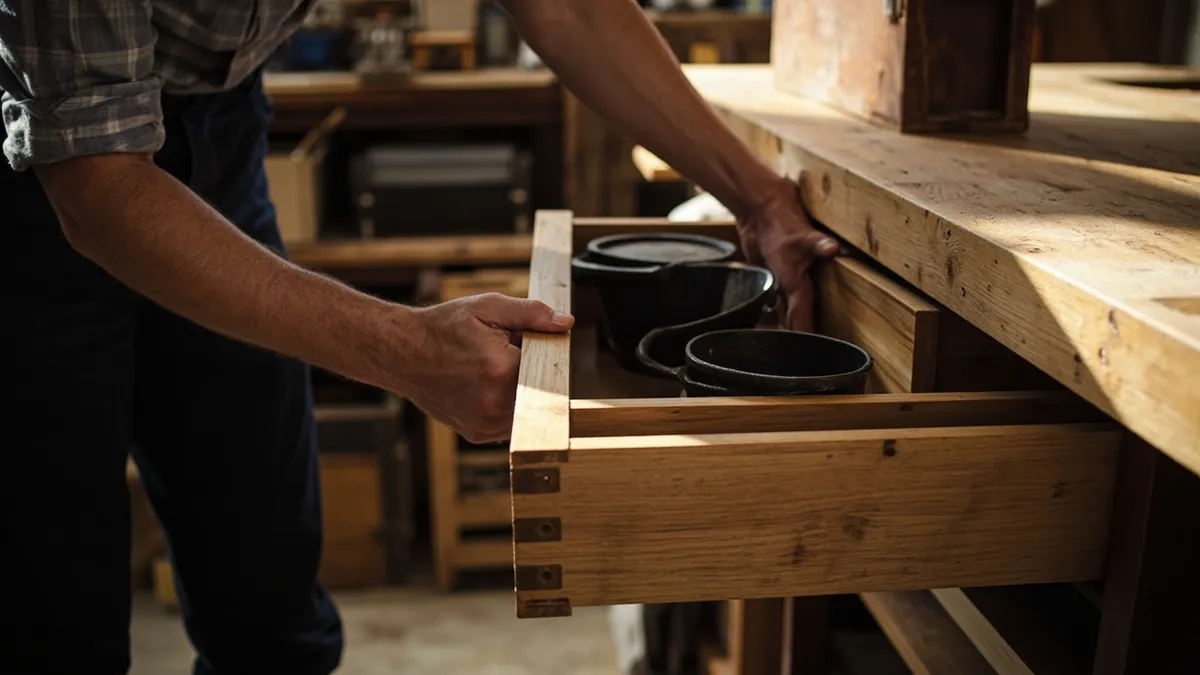
Oak & Pine by Design builds dovetailed solid timber boxes as standard in its Honley workshop, rather than offering them as a showroom upgrade. Even so, the workshop would not prescribe a particular joint without weighing the drawer's size, contents and hardware. Customers visiting from across the United Kingdom often see the difference in person before they commit.
The honest disadvantages
The real drawbacks are the extra time and skill needed to cut and fit each joint accurately. A poor dovetail, loose groove or badly prepared joint gives no advantage over a well-made dowelled, rebated or mechanically fastened corner.
Dovetails also cannot rescue a flimsy base, weak fixings or inadequate runners, and they cannot stop solid timber from shifting as indoor humidity changes, which is why seasoned timber and sensible box design still matter.
What to check on the quotation
- Ask whether the box is solid oak, pine, maple, walnut or another named timber, rather than a faced board.
- Check how the base sits in its groove and whether every fixing remains accessible for later repair.
- Confirm the runners are load-rated for the drawer's intended contents and compatible with soft-close operation.
- Inspect a finished sample in the workshop, not a close-up photograph of the corner joint.
For pan drawers, favour solid timber sides, four-corner dovetails and a captured base, then specify the runner to suit the load. For occasional-use drawers, judge the whole specification before focusing on the joint.
Your next decision
Bring a typical load or measure the pots you expect to store, then open a finished sample at the Honley workshop. Pull it hard, twist the front and watch the runner movement; those three actions reveal more than the joint name alone.
Dovetail Drawers: Disadvantages, Advantages and What to Check on a Quote
The honest disadvantages of dovetail drawers
The main drawback is the time and skill it takes to cut and fit each corner well. Pins and tails cut by eye take longer than stapling a box together, and a sloppy dovetail is genuinely weaker than a clean alternative joint. The joint only carries the corners; it does nothing for the base, the runner, or how the drawer handles a slammed pan.
A second drawback is that the joint leans entirely on the workshop cutting it. Mass-produced machine dovetails vary widely in tolerance, and thin plywood sides cannot hold a tail the way 18 mm solid oak can. If the specification behind the joint is poor, the dovetail is decoration, not structure.
Why dovetail drawers are better where it matters
Dovetail drawers earn their place in heavy, hard-worked drawers because the interlocking joint resists the racking force of a deep pan drawer being pulled open and loaded daily, and it tightens rather than works loose under load. A solid timber dovetailed box can also be re-glued and re-pinned years later, which a stapled MDF box cannot.
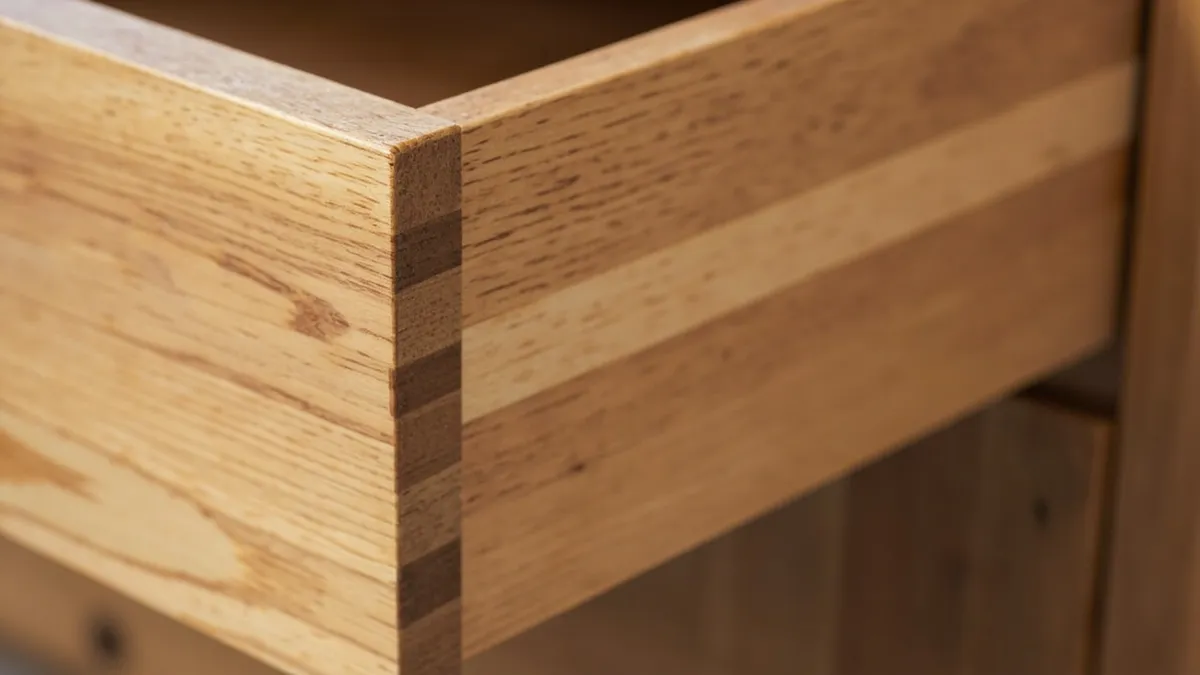
On any quote, judge the whole drawer, not one corner. Check the box material (solid oak or beech beats faced MDF), the base (a plywood panel set in a groove, not stapled from below), the runners (load-rated soft-close, sized to the drawer weight) and the back fixings. A drawer with a dovetail on a 12 mm melamine carcass is a marketing choice, not a quality choice.
If you want to feel the difference yourself, book a showroom visit to the Honley workshop and pull open a finished drawer before you decide.
Common Questions and How to See the Drawers for Yourself
What are the disadvantages of dovetail drawers?
The honest drawbacks are time, skill and what the joint cannot do. Cutting a dovetail properly, by hand or machine, takes longer than stapling or dowelling a box, and a poorly cut dovetail is weaker than a well-made alternative. The joint also has no say over the quality of the runner under it or the base sitting in it, so a dovetailed drawer on a cheap runner will still fail where most drawers actually fail.
Why are dovetail drawers better?
Dovetail drawers earn their reputation in the daily grind of a working kitchen, because the angled teeth lock into one another and refuse to give way when a hand yanks the front sideways. That mechanical wedging grows firmer with each cycle of loading, which is why a hardwood drawer built this way can be taken apart, fresh glue applied, pins reset or a face re-shaped many years on. In a room where pans rattle and cutlery flies out twice a day, that quiet endurance is what the joint is really paying for.
What are the disadvantages of using dovetail joints?
The joint is only as good as the timber it is cut from and the hands that cut it. A through-dovetail in poorly seasoned wood will move as the seasons change, and a half-blind dovetail cut too loose will show its gaps on the drawer front. Joints also do not fix weak specification elsewhere, so the box material, base and runners must still be chosen carefully.
Do dovetail drawers last longer?
A well-cut dovetail in seasoned hardwood will usually outlast the kitchen around it. Because the joint is mechanical rather than reliant on glue or staples alone, it keeps its shape under load, and a solid timber box can be taken apart and repaired years later instead of being replaced. On a quality kitchen, dovetailed solid timber boxes are built in as standard rather than offered as an upgrade.
Quick answers
- Drawbacks: slower to produce, demanding on timber, useless if the runner is cheap.
- Advantages: resists racking, can be repaired, often outlasts the kitchen around it.
- Value view: judge the whole drawer specification, not one joint.
- Joint drawbacks: a bad dovetail is worse than a good alternative.
Visit the Honley workshop or talk to us about your kitchen
Every drawer that leaves our Honley workshop is dovetailed solid timber, made that way as standard rather than offered as an extra, and the workshop holds Guild of Master Craftsmen recognition for the trade. Come and pull one open in person, call 01484 666 333, or email info@handmadekitchensyorkshire.co.uk to start a conversation about your kitchen. Past projects, finished drawer close-ups and customer reviews can also be seen on the workshop's Houzz profile.
Sources
- Wood Handbook, Chapter 7: Strength of Joints - U.S. Forest Products Laboratory
- Are Solid Wood Dovetailed Drawers Worth It? - Woodweb.com
See the work for yourself
Photographs only go so far with timber. The grain, the weight of a door and the feel of a drawer running true are things you have to handle. Every kitchen we make is built by hand in our Honley workshop, and you are welcome to come and see one being put together.
To talk through your kitchen or arrange a visit, book a showroom visit, call 01484 666 333 or email info@handmadekitchensyorkshire.co.uk.