
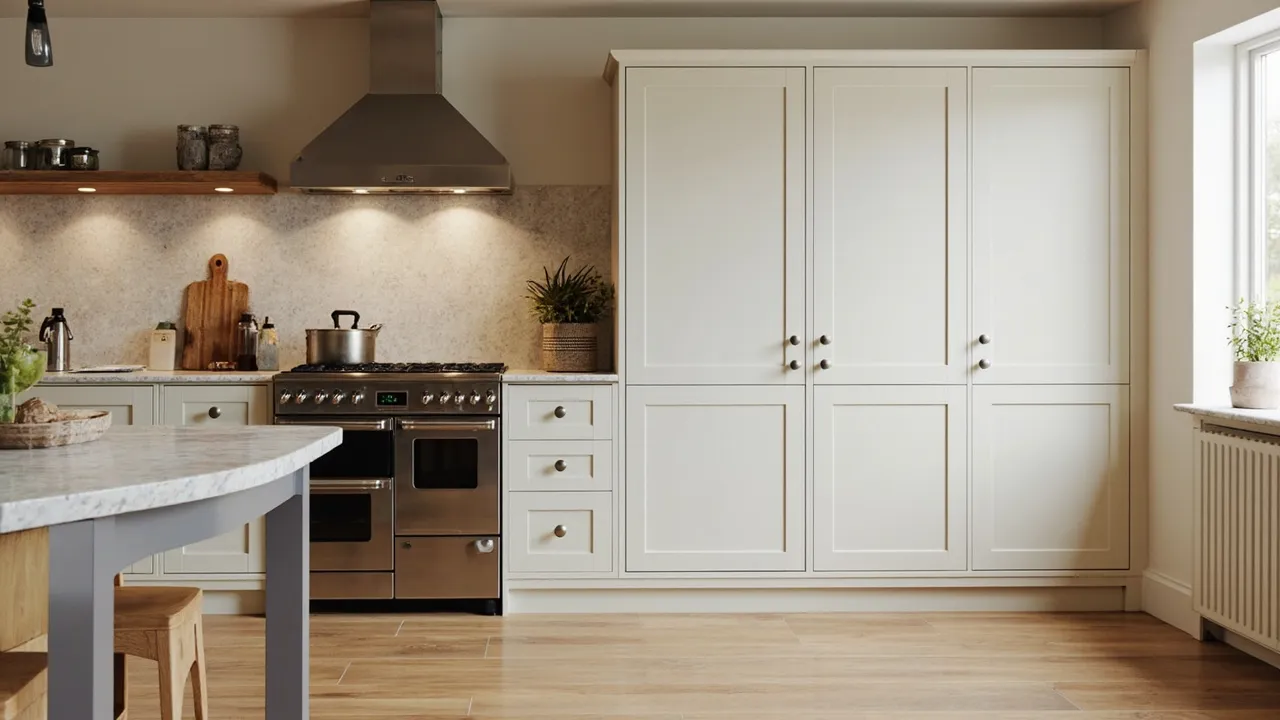
Painted kitchen cabinets can be hand-painted or factory-sprayed. Spraying gives a flat, uniform coat; hand-painting gives a softer finish with a slight brush texture, and it is far easier to touch up or repaint in another colour years later.
We have been hand-painting furniture and kitchens for over 25 years in Yorkshire, and we paint by hand in our workshop at Crossley Mills in Honley. Here is an honest look at both finishes, which doors take paint well, and what happens when you fancy a change of colour.
Key takeaways
- Yes, you can paint kitchen cabinets, but the result depends on the door material and the preparation more than the paint.
- A sprayed finish looks uniform; a hand painted kitchen has a softer, traditional character and is simpler to repair.
- Solid timber doors can be sanded, filled and repainted many times over their life.
- We can paint in any colour, with a colour-matching service.
Can you paint kitchen cabinets?
Yes. Almost any cabinet can be painted, but not every cabinet will hold paint well. Paint needs something to grip. Bare or properly sanded solid timber takes primer and paint very well. Shiny foil-wrapped or laminate doors are much harder, because the surface is sealed and slippery, and paint on them tends to chip at the edges. MDF takes paint well on its faces, though its cut edges need sealing first, and it cannot be sanded back and reshaped in the same way as solid wood if it is damaged.
That is one reason we make painted kitchen cabinets from solid timber. A solid frame-and-panel door, joined with mortise and tenon, can be sanded, filled and repainted many times. If you are weighing up materials, our guide to solid wood vs MDF kitchen doors goes into more detail.
Is it better to hand-paint or spray kitchen cabinets?
Both are good finishes when they are done well. They simply suit different kitchens and different owners.
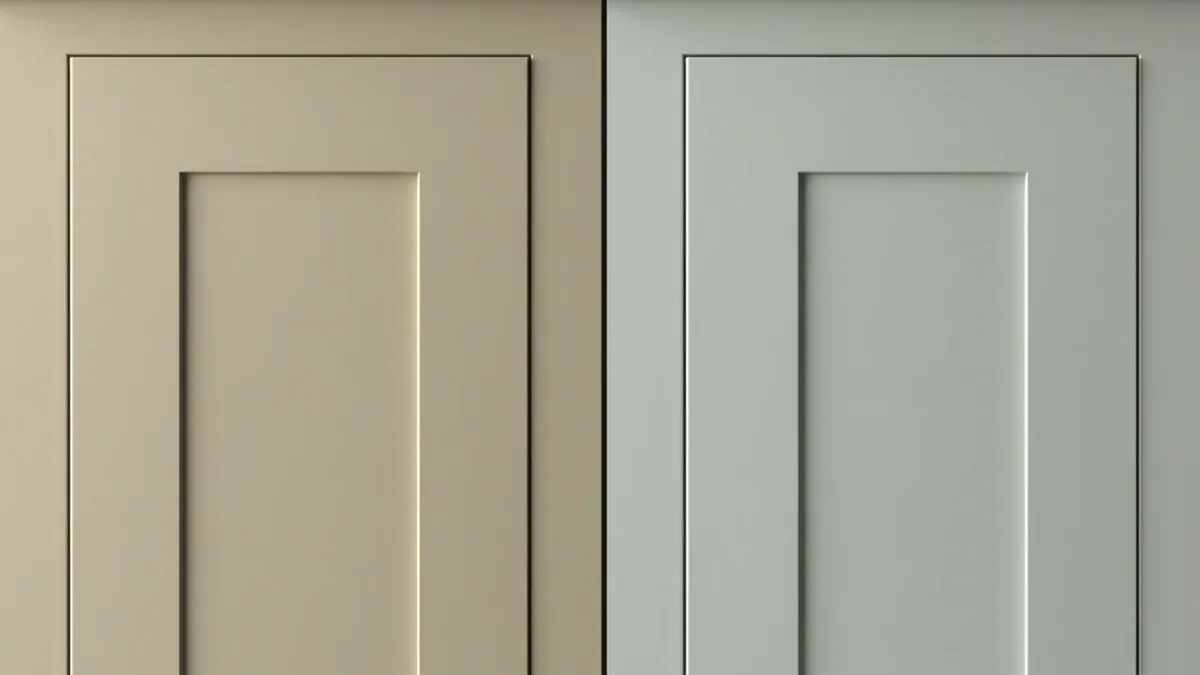
| Hand-painted | Factory-sprayed | |
|---|---|---|
| Look | Soft, traditional, a gentle brush texture | Flat, very even, uniform sheen |
| Where it is done | In the workshop, and touched up in your home | In a spray booth |
| Small chips and knocks | Easy to touch up by hand so the repair blends in | Harder to repair invisibly once fitted |
| Changing colour later | Straightforward to repaint by hand in place | Usually means removing doors or living with a brushed finish over a sprayed one |
| Suits | Shaker, in-frame, farmhouse and period kitchens | Sleek, handleless and very modern designs |
For traditional solid wood, Shaker and in-frame kitchens, hand-painting fits the character of the joinery. You can see the craft in it, and it will forgive the knocks of family life. We cover more on why we prefer it in our post on painted kitchen colours, which also helps with choosing a shade.
Which timbers and doors are best for painted kitchen cabinets?
Close-grained, stable timbers give the smoothest painted finish. Open-grained timbers such as oak show their grain through the paint unless the grain is filled first, which some people love and others don't. Knotty pine needs its knots sealed so resin does not bleed through the paint over time.
Door style matters too. A Shaker door, with its plain recessed panel, paints beautifully, and the crisp edges of the frame give a clean line. Our handmade Shaker kitchens are a natural choice for a painted finish. Heavily moulded doors can be painted too, but they take longer, because every profile needs to be primed and brushed properly.
Whatever the timber, we prime and paint every face of the door, including the back and edges, so moisture moves in and out evenly. That helps the door stay stable through damp Pennine winters and centrally heated kitchens.
How are painted kitchen cabinets prepared?
Preparation is where a painted finish is won or lost. In the workshop our steps for new painted kitchen cabinets look like this:
- Sand the timber smooth and remove dust.
- Seal knots and fill any small defects or open grain.
- Apply primer and undercoat, lightly sanding between coats.
- Apply the top coats by brush, working with the grain and along the joints.
- Let each coat dry and harden properly before the next.
- Touch up any marks on site after installation.
Repainting an older kitchen is similar, but first everything has to be cleaned thoroughly, because kitchen grease stops paint sticking. Old, flaking layers may need stripping back. Take care with very old painted joinery: lead paint may still be found in older properties painted before regulations restricted its use, so get professional advice and have it tested before sanding or stripping. Our paint stripping and restoration service deals with old painted pine and period pieces.
How long does a hand-painted kitchen last?
We won't put a number of years on it, because it depends on how the kitchen is used and cared for. What we can say is that a well-prepared hand painted kitchen on solid timber does not have a fixed end date. The paint will pick up knocks over time, particularly around handles, the bin cupboard and the plinth where boots and dog bowls live. Those marks can be touched up, and the whole kitchen can be refreshed with a new coat rather than replaced.
Simple care helps: wipe spills promptly with a soft damp cloth, avoid harsh abrasive cleaners, and keep a little of your paint for small touch-ups. In farmhouses and stone cottages around the Holme Valley, where the kitchen is the busiest room in the house, that easy repair is a big part of the appeal.
Can a painted kitchen be repainted later?
Yes. Painted kitchen cabinets in solid timber can be refreshed many times, and this is one of the best reasons to choose solid timber and a hand-painted finish. Repainting a kitchen means cleaning, lightly sanding to give a key, priming any bare spots and applying new top coats. Because the original finish was applied by hand, a new brushed coat sits naturally on it. Doors can often be painted in place, which keeps disruption down.
Many people choose a quiet colour at first, then repaint the island or lower cupboards in a stronger shade a few years later. We can match any colour, including one taken from a fabric, a tile or an existing piece of furniture, with our colour-matching service.
What we'd do: a rule of thumb from the workshop
If we were choosing painted kitchen cabinets for our own home, we would pick solid timber doors, a traditional frame-and-panel or in-frame design, and a hand-painted finish. We would leave the worktop and perhaps an island in natural wood for warmth, and keep a small tin of each colour labelled in the utility cupboard. And we would never let paint go onto doors that had not been primed on every face first.
It is the same approach we take on every commission, from design through to installation. You can read how that works on our process page.
What should I bring to a showroom visit?
- Photos and rough measurements of your kitchen.
- Any colour you want matched: a fabric swatch, a tile, a cushion or a paint chip.
- Pictures of painted kitchens you like, and any you don't.
- A note of how hard the kitchen works: children, dogs, muddy boots, a busy range.
- Questions about existing cabinets you'd like repainted or restored.
In the showroom you can see and touch a hand-painted finish next to natural timber, and look at the joinery behind it. Browse our hand-painted kitchens before you come.
Talk to us about a hand-painted kitchen
Book a free consultation with Daniel Fitzpatrick, owner and master craftsman at Oak & Pine by Design. We design, make and hand-paint solid wood kitchens in our Yorkshire workshop, in any colour you choose, and give you a detailed written proposal. Visit our showroom at Crossley Mills, Honley, by appointment, and you're welcome to see your kitchen being made and painted.
Call 01484 666 333, email info@handmadekitchensyorkshire.co.uk, or contact us online. See more of our painted kitchens range.
Frequently asked questions
Can you paint kitchen cabinets without sanding?
Skipping preparation is the most common reason painted cabinets chip and peel. Paint needs a clean, keyed surface to grip, so cabinets should be degreased and lightly sanded, then primed. On solid timber this is straightforward; on shiny laminate or foil-wrapped doors, getting a lasting finish is much harder.
Is a hand-painted kitchen more practical than a sprayed one?
For family kitchens, often yes. A sprayed finish is very even, but chips are hard to repair invisibly. A hand-painted finish can be touched up by brush and blends back in, and the whole kitchen can be repainted in place when you want a new colour.
Can you match a colour I already have?
Yes. We can paint in any colour and offer a colour-matching service, so bring a sample along: a fabric, a tile, a painted object or a chip from an existing wall. We'll match it as part of the design.
Do you repaint existing kitchens?
We offer paint stripping and restoration, and we are happy to talk about existing solid wood cabinets you would like refreshed. Get in touch with photos and we'll give you an honest view on whether repainting or restoring makes sense for your kitchen.