
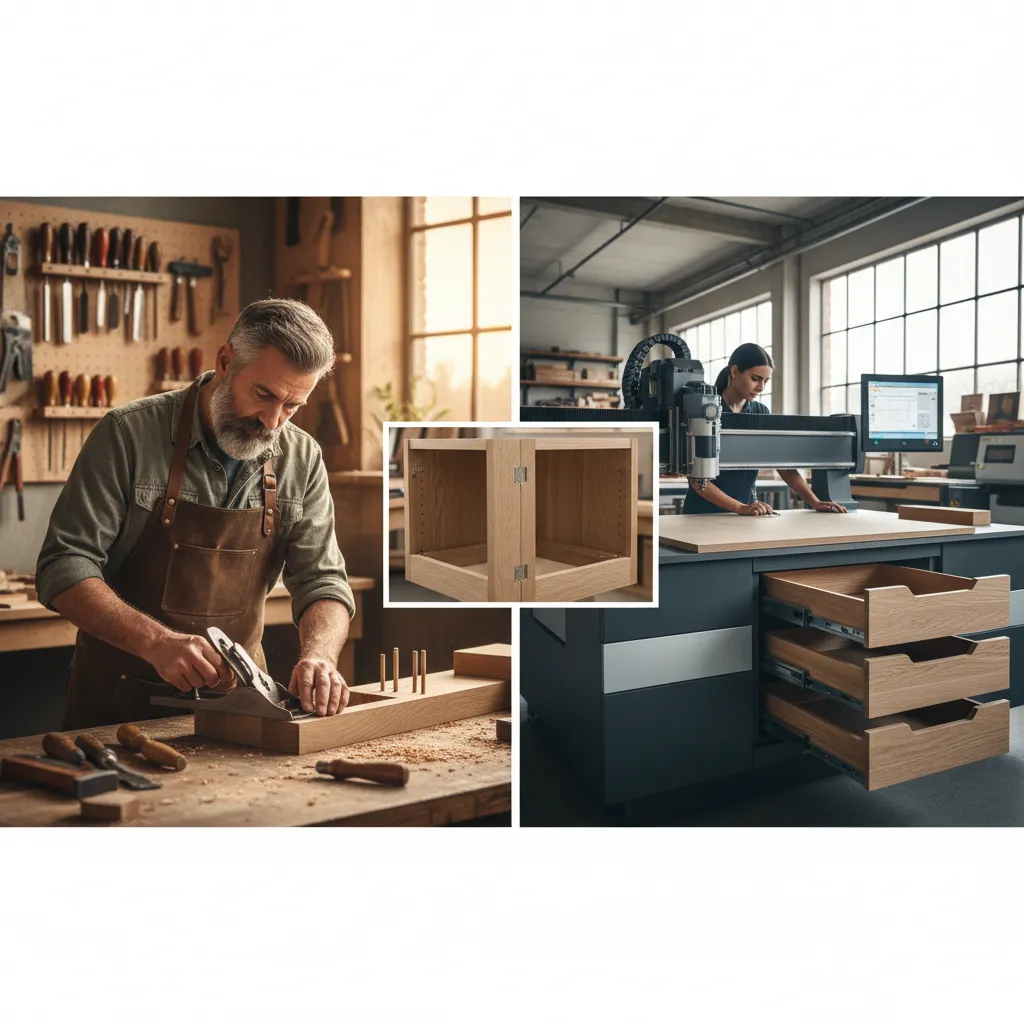
Quick answer: traditional vs modern kitchen joinery methods
The short version
Traditional kitchen joinery relies on interlocking wood joints, such as mortise-and-tenon and hand-cut dovetails, shaped with hand tools by a skilled craftsman.
Modern kitchen joinery leans on mechanical fasteners, adhesives, biscuit joints, pocket holes, and CNC-machined finger joints built for speed and consistency.
What "traditional" really means at the bench
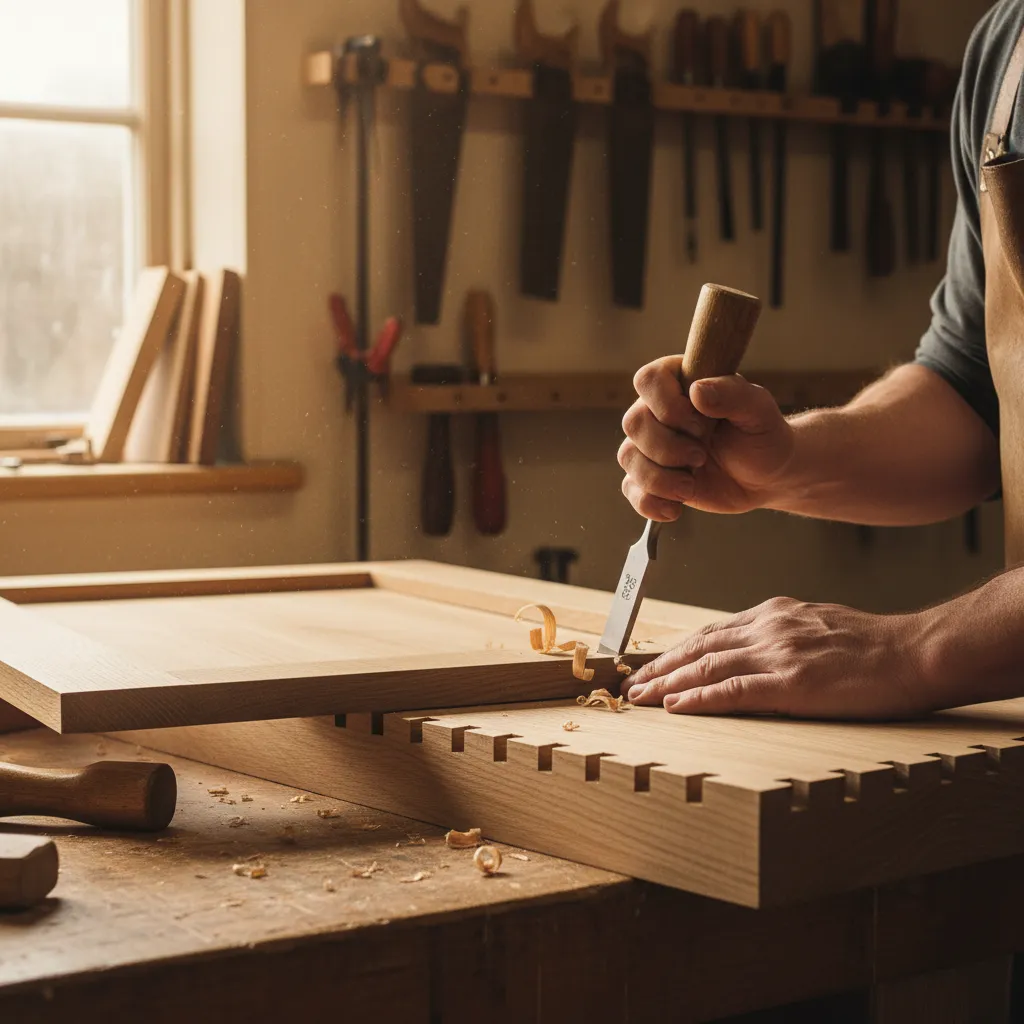
A traditional joiner cuts each joint to fit its mating piece, the way a cabinetmaker has done for centuries. Hand-cut dovetails on drawer fronts, through-mortise-and-tenon frames around Shaker-style cabinet doors, and raised-and-fielded oak panels all sit in this category. The joint does the structural work, so glue plays a supporting role rather than carrying the load. A 19th-century Yorkshire kitchen dresser is the clearest example: joints tightened as the timber settled, and the piece is still usable today.
What "modern" looks like on a factory floor
Modern methods favour repeatable production. Flat-pack and mid-range cabinets rely on cam-lock fixings, dowels, MDF carcases, and machine-cut finger joints that a single operator can produce hundreds of per hour. The result is faster turnaround and lower cost, with consistent tolerances and easier integration of soft-close hinges and pull-out fittings. The trade-off is that a failed fastener usually means replacing the whole component.
The practical difference for your kitchen
If you want a one-off kitchen shaped to an older Yorkshire property, with irregular walls and a heritage feel, traditional joinery fits better. If you want a clean, modular layout delivered on a set budget within weeks, modern methods make more sense.
Kitchen Styles, Cabinet Doors, and What Buyers Often Ask Before Committing
Key Differences Between Traditional and Modern Kitchens (And the 2026 Direction)
Traditional kitchens centre on hand-cut joints, solid timber, and visible craftsmanship. Modern kitchens rely on machine-cut components, sheet materials, and concealed hardware. The traditional approach uses mortise-and-tenon frames and hand-cut dovetails that tighten with age, while the modern approach favours cam locks, pocket screws, and flat-pack assembly for speed.
For 2026, the direction is hybrid: in-frame Shaker cabinets with hand-finished doors paired with soft-close hinges, integrated LED lighting, and discreet charging drawers. Buyers are keeping the joinery visible and the hardware quiet.
The Four Kitchen Layouts and the Modern Cabinet Doors Worth Knowing
The four kitchen layouts are single-wall, galley, L-shape, and U-shape, each dictating how cabinetry, worktop runs, and appliances sit in relation to one another.
- Single-wall: all units on one side, common in flats and loft conversions.
- Galley: two parallel runs, suited to narrow Yorkshire terraces.
- L-shape: two adjoining walls, leaving space for a dining table or island.
- U-shape: three walls of cabinetry, the most storage per metre.
Modern cabinet doors to know are slab (flat, handle-less, often walnut or painted), Shaker (five-piece frame with a recessed centre, the most common bespoke choice), handleless J-pull (a routed groove along the top edge), and glass-fronted (for display cabinets beside an AGA or dresser).
Before committing, decide the layout, then choose the door style, and only then specify the timber. Reversing that order usually forces compromises on cabinet run lengths. For a tailored quote, bring your room measurements and a few reference photos to the workshop at Oak & Pine by Design.
Speak With Our Yorkshire Workshop About Your Bespoke Kitchen
Choosing between traditional and modern joinery shapes how your kitchen feels and performs for the next 30 years. If you want the honest view from people who cut dovetails by hand every day, the workshop at Oak & Pine by Design is open for a conversation.
Daniel Fitzpatrick leads every project from the first site visit through to installation, with over 25 years of master craftsmanship behind him. As a Guild of Master Craftsmen accredited workshop, we hand-cut mortise-and-tenon joints, dovetail drawers, and fit solid oak, walnut, maple, beech, and reclaimed pine cabinetry in our single Yorkshire workshop. That single point of control means the person quoting your kitchen is also building it, so nothing gets lost between a salesperson and a factory floor.
A short phone call or email is often the most useful next step. Have your room measurements, a sense of the timber you like (oak, painted, Shaker, or something else), and any photos of the space to hand. We will talk you through the trade-offs: where traditional joinery earns its cost, where modern hardware such as soft-close hinges earns its place, and how a hybrid approach can give you both. Many clients arrive unsure whether they want an in-frame Georgian style or a simpler modern shaker layout; a 20-minute chat usually clarifies the direction.
To start that conversation, call the workshop on 01484 666 333 or email info@handmadekitchensyorkshire.co.uk. You can also reach the team through the contact page to book a home visit across Yorkshire and the wider UK.
Sources
- Time-Honoured Joinery Methods for Contemporary Kitchens: Build Quality That Endures
- Reimagining Your Kitchen: How Joinery Shapes Today's Interior Layouts
- Contemporary Carpentry Against Age-Old Woodworking Methods - Facebook
- Cabinet Contemporary Kitchen Against Classic Kitchens
- Defining Joinery Within the Building Trade | OPPEIN
- Woodworking Aesthetics: Heritage Craftsmanship Meeting Contemporary Practice - Raymond Good (Joiners) Ltd
- The Quiet Skill of Woodwork: How East Asian Heritage, Western Tradition, and Present-Day Methods Converge in Mim Concept Furniture
- Timber Joints Side by Side: Heritage Practice Against Modern Production | Bay & Bent | USA