
Quick answer: traditional joinery techniques handmade kitchen
Direct answer
A traditional joinery techniques handmade kitchen is built with hand-cut joints such as mortise-and-tenon, dovetail, and tongue-and-groove, never staples or cam locks.
These joints give cabinets and drawers a tighter, longer-lasting fit and a finished surface you can see and feel.
That hand-cut fit is the line between a true handmade kitchen and a mass-produced one. For homeowners weighing bespoke options against high-street brands, the joinery is where the value sits.
What are some traditional joinery techniques?
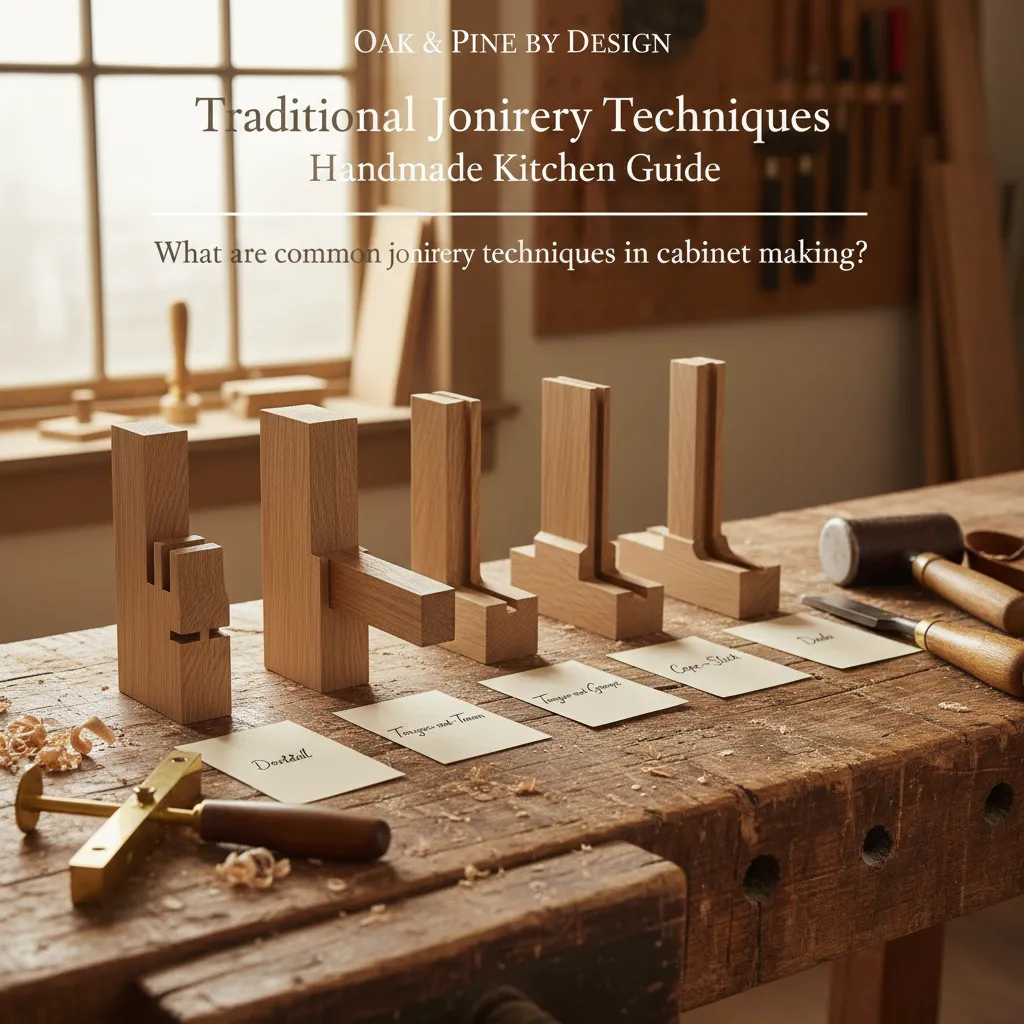
Mortise-and-tenon, dovetail, tongue-and-groove, and dado are the four traditional joinery techniques you will see most often in a handmade kitchen. Mortise-and-tenon locks frame members together with a square peg seated in a matching cavity. Dovetail interlocks wedge-shaped tails and pins at drawer corners. Tongue-and-groove lets wide panels expand and contract with humidity. Dado slots fixed shelves into a carcass side.
A quick drawer test tells you which you are looking at: visible dovetails at the corners mean handmade. Staples or glued mitres mean factory assembly.
What are some traditional carpentry techniques?
Hand-cutting joints with chisels, mallets, and shoulder planes is the core skill. Reading timber grain to orient every board matters too. Hand-finishing surfaces with scrapers, glasspaper, and oil or paint completes the build.
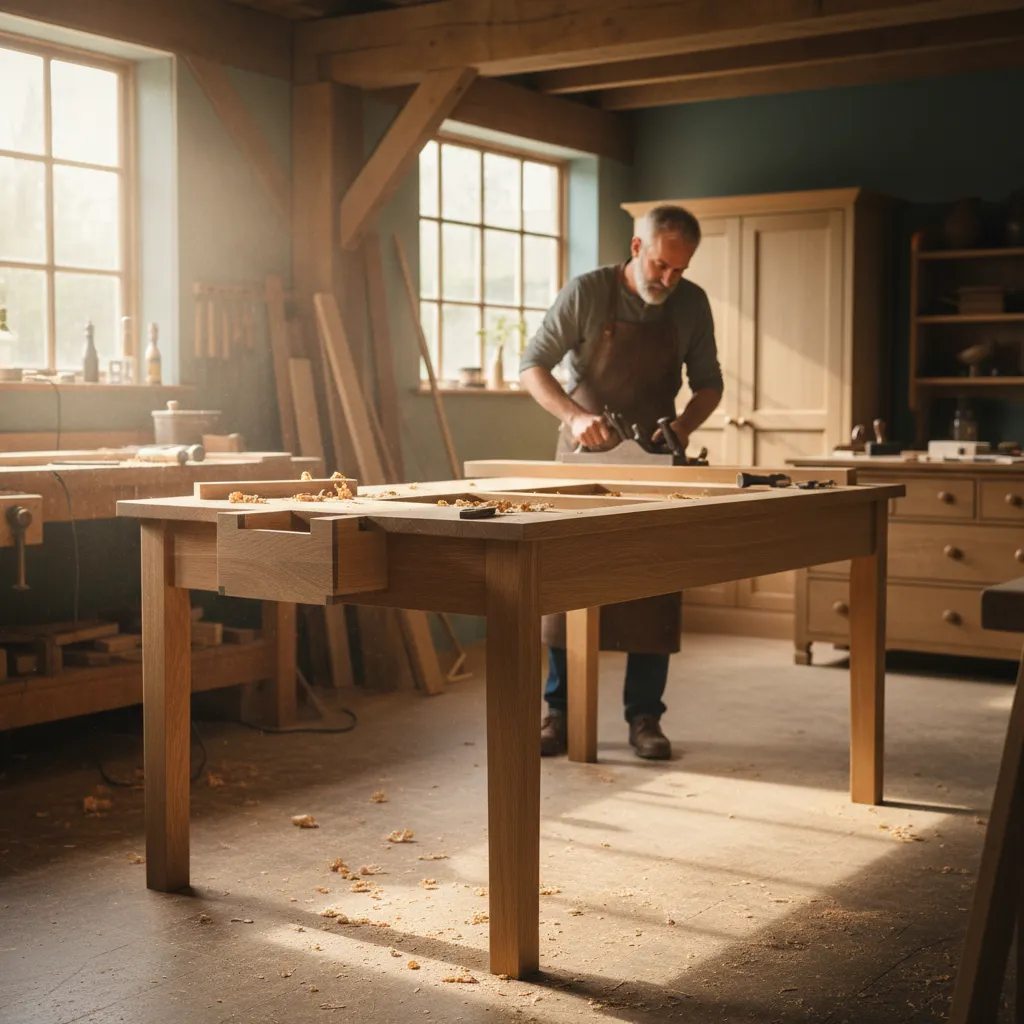
In our Yorkshire workshop, a drawer is cut, dovetailed, sanded, and fitted on a wooden slide by hand. Founder Daniel Fitzpatrick has refined this sequence over more than 25 years of master craftsmanship under Guild of Master Craftsmen accreditation.
What are common joinery techniques in cabinet making?
Cope-and-stick for framed doors, mortise-and-tenon for face frames and table legs, dovetail for drawer boxes, tongue-and-groove for centre panels, rabbet for back panels and drawer bottoms, and dado for fixed shelves. Each joint is chosen for the load and seasonal movement it has to handle, not for speed on a production line. This is the carcass construction behind every kitchen that leaves our workshop.
Practical next step
Bring your room measurements and a short list of must-haves to the workshop. Email info@handmadekitchensyorkshire.co.uk or call 01484 666 333 to book a design consultation with Oak & Pine by Design, or visit our contact page at handmadekitchensyorkshire.co.uk/contact-us.
Common questions about traditional joinery techniques handmade kitchen
What are some traditional joinery techniques?
Mortise-and-tenon, dovetail, tongue-and-groove, dado, rabbet, and cope-and-stick are the traditional joinery techniques most often used in a handmade kitchen. Mortise-and-tenon frames cabinet doors and table legs. Dovetails lock drawer corners. Cope-and-stick builds shaker kitchen doors with a floating centre panel that moves with seasonal humidity. These are also the joints you will see in a shaker kitchen built to last.
What are some traditional carpentry techniques?
Hand-cutting joints with chisels and saws, planing boards flat by eye, fitting doors to openings rather than the reverse, and hand-finishing with oils or paints are core traditional carpentry techniques. In our Yorkshire workshop, Daniel Fitzpatrick still trims each painted unit door with a shoulder plane so the 1/32 inch gap stays consistent across the run. Hand painting and finishing is what gives a wooden kitchen its depth.
What are common joinery techniques?
Common joinery techniques include those above plus finger joints, dowels, mitres, and simple butt joints. The drawer test is the fastest way to tell them apart in a finished kitchen: hand-cut dovetails at the corners signal a proper handmade build. Staples or glued mitres signal a flat-pack carcass.
How to make a modern kitchen look traditional?
Swap slab doors for in-frame shaker kitchen doors with a cope-and-stick build. Choose oak or walnut worktops over composite stone. Fit visible dovetailed drawers on soft-close runners. Hand-painted cabinet fronts in muted colour palettes and a butler-style Belfast sink complete the shift without losing modern storage. An oak worktop will outlast three sets of laminate replacements.
Mortise-and-tenon vs dovetail: which joint belongs where?
Use mortise-and-tenon for door frames, face frames, and table legs where the joint must resist racking. Use dovetails for drawer corners where pull-out forces would pull a mechanical fastener apart. In our carcasses, oak and tulip wood frames carry mortise-and-tenon joinery, while walnut and maple drawer boxes get through-dovetails. This is the rule of thumb we apply to every handmade kitchen we build.
Bespoke vs handmade: what is the real difference?
Bespoke means the cabinetry is sized to your room rather than pulled from a catalogue. Handmade means each component is cut, jointed, and finished by hand in a workshop such as ours. A bespoke kitchen can still be machined. A handmade kitchen should arrive with visible joint lines and hand-planed surfaces you can feel under your thumb. Bespoke handmade kitchens in oak, pine, beech, and walnut sit at the top of that scale. Bespoke kitchens and furniture cut on a CNC router sit further down.
Visit our Yorkshire workshop to see mortise-and-tenon, dovetail, and cope-and-stick joints cut by hand before you commit to a design. Call 01484 666 333 or email info@handmadekitchensyorkshire.co.uk to book a consultation.
Speak with a Yorkshire workshop and plan your bespoke kitchen
When a handmade kitchen makes sense, and when it does not
A traditional, hand-built kitchen earns its keep when you plan to stay in the house for at least 15 years. It also suits buyers who want cabinetry that can be re-finished rather than replaced, and who want a workshop that talks to you directly about door styles and drawer build. It makes less sense if you are listing the property within two years, working to a tight builder's-package budget under £15,000, or need a flat-pack speed turnaround.
Trade-offs worth naming now: lead times of 8 to 14 weeks versus roughly 2 weeks for a rigid unit, and the need for an accurate on-site survey before any timber is cut. Daniel Fitzpatrick measures every opening himself before a single board is selected. The other honest trade-off is timber movement: a solid oak worktop will move with the seasons and needs oiling twice a year. A walnut or tulip wood interior is more stable but costs more per square foot.
If you are weighing a handmade kitchen against a high-street fitted brand, the honest test is the drawer. Lift a sample drawer and look at the corners. Hand-cut dovetails and mortise-and-tenon doors age tighter. Staples and cam locks loosen within five years of daily use. Our shaker kitchen drawers are dovetailed front and back, not just at the show face.
Your next step: a design conversation with Oak & Pine by Design
Call 01484 666 333 or email info@handmadekitchensyorkshire.co.uk to arrange a measured visit at your home, or reach us through our contact page at handmadekitchensyorkshire.co.uk/contact-us. You will leave the meeting with a written quotation, a timber sample board covering oak, pine, beech, mahogany, maple, painted, reclaimed pine, and shaker styles, and a fixed installation date.
Sources
- A Look at Time-Honoured Jointing Methods in Amish Cabinetry | Amish Exclusive
- Understanding Wood Joinery: Varieties, Strengths & Working Methods
- Tracing the Roots of Classical Timber Joinery
- The Craft of Jointing: Why Heritage Woodworking Methods Endure in Contemporary Pieces | Frailey Woodworks
- Refining Furniture Joinery: Seventeen Professional Methods for Sturdy, Elegant Creations | Anderson Woodworks
- Amish Traditions in Cabinetry Assembly | Amishwerks
- An Introductory Handbook on Timber Joinery | Shaper Tools
- CabinetNow's Resource on Wood Joinery