
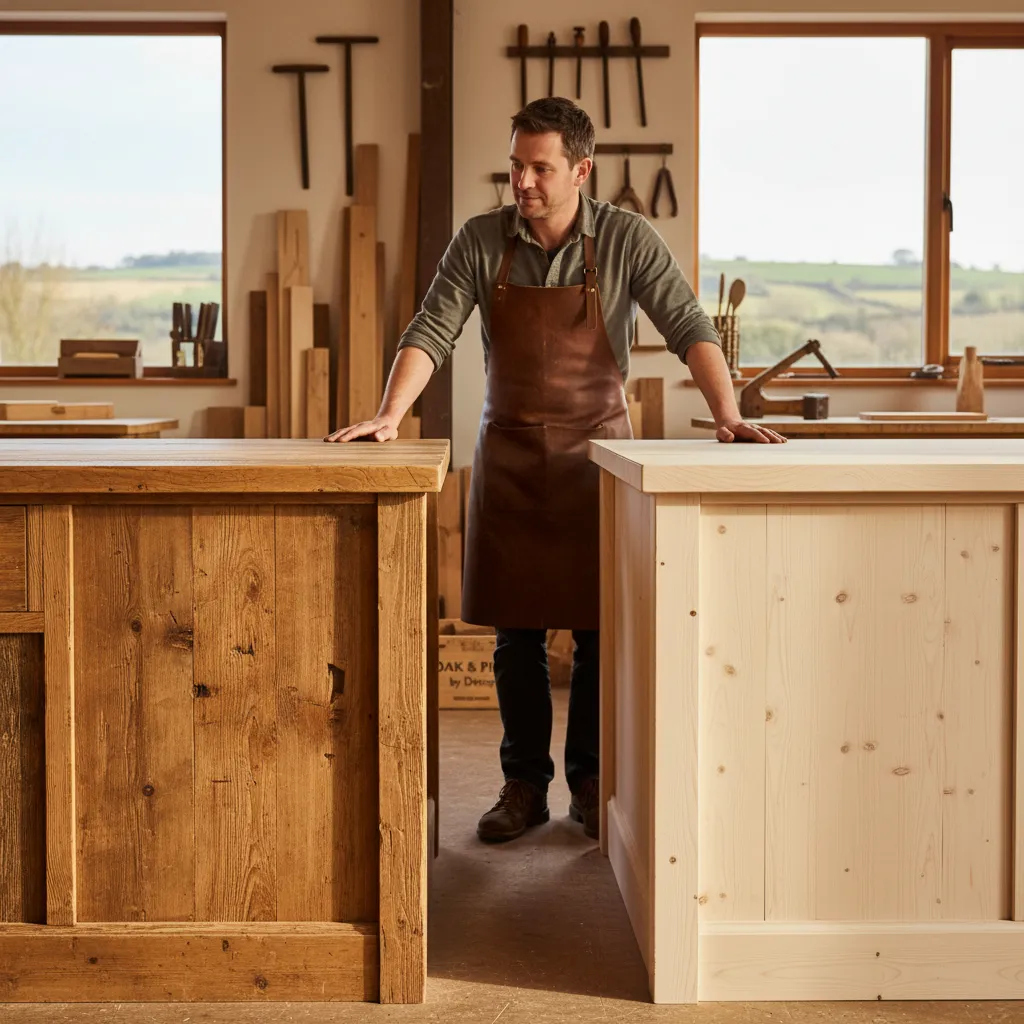
Quick answer: reclaimed pine vs new pine for bespoke kitchen
Direct comparison
The choice in reclaimed pine vs new pine for bespoke kitchen work comes down to aged character against predictable uniformity.
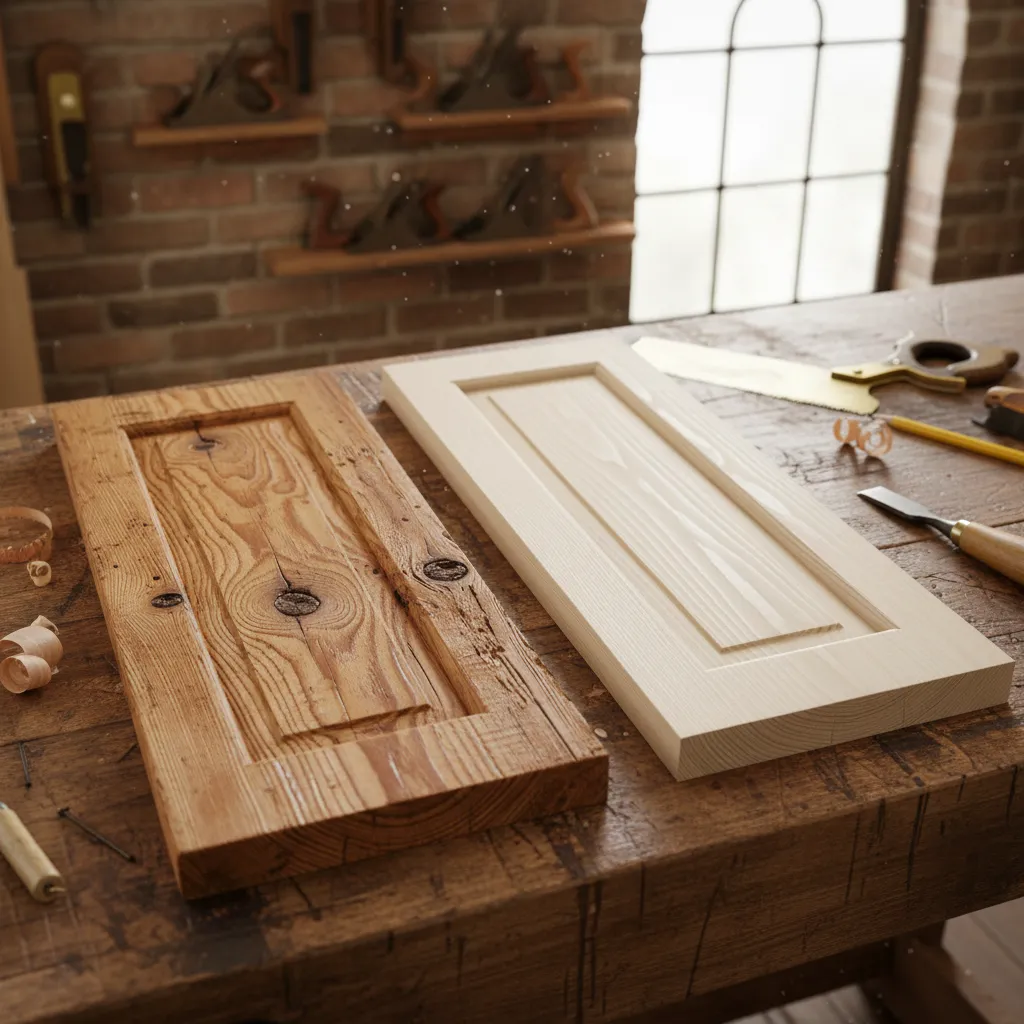
Reclaimed pine brings warmth, patina, and history from old beams and boards; new pine offers pale colour, clean grain, and easier machining for precise joinery. Each suits a different brief.
For homeowners weighing reclaimed pine vs new pine for bespoke kitchen cabinets, the deciding factors are three: the look you want, the tolerances your joiner needs to hit, and how the timber will behave in a kitchen's humidity. None of the three is a deal-breaker on its own; together, they narrow the choice quickly.
When reclaimed pine earns its place
Reclaimed pine suits farmhouse, shaker kitchen doors in painted ranges, and rustic schemes where knots, nail holes, and weathered grain are wanted rather than hidden. The amber and reddish tones settle well with warm stains and painted finishes in cream, sage, or deep blue. A door made from a 19th-century Yorkshire roof beam carries provenance that new timber cannot match, and it often outpaces oak kitchen stock for sheer warmth on an island end. Mahogany and maple accents sit comfortably alongside reclaimed pine on internal drawer linings and feature shelves, where the contrast of dense tropical timber against soft Yorkshire pine lifts the joinery without shouting.
When new pine is the better call
New pine is the right choice for pale Scandinavian finishes, a modern shaker kitchen, and any run of cabinetry that needs tight, matching tolerances across metres of carcass. It machines cleanly, takes a consistent finish, and moves predictably as humidity changes through the year. For painted kitchen units built around long runs, new pine gives a joiner the consistency reclaimed boards simply cannot promise. Where the brief asks for painted shaker doors in beech-stained surrounds, new pine keeps the lines crisp.
The trade-off to know
Mixing old and new pine in the same run of doors is where bespoke handmade kitchens in oak, pine, and other timbers can go wrong. Old pine is denser and tougher than new pine, so the two stain, sand, and shrink at different rates, leaving visible gaps and uneven colour within months. Decide on one or the other per surface, or keep new pine for structural carcasses and reclaimed for feature panels only. If a client wants oak doors alongside pine cabinets, our workshop treats that as a separate specification rather than a mixing exercise within a single run.
Budget reality
Reclaimed pine often costs less than people expect, sometimes less than premium new pine, because supply from dismantled barns and mills is steady. The labour is higher: de-nailing, metal-detecting, and re-milling take hours before the joiner sees a usable board. New pine is cheaper in material but cleaner to prepare, which is why so many wooden kitchen quotes land where they do. A reclaimed oak feature will push the figure higher still, so the choice of species matters as much as the choice of new versus old.
A practical first step
Bring a sample of your wall tile, floor finish, and worktop to a consultation so the timber can be matched to scheme in the room, not on paper. Call 01484 666 333 or visit the contact page to book a workshop visit in Huddersfield.
Common questions about reclaimed pine vs new pine for bespoke kitchen
Is reclaimed pine good quality?
Reclaimed pine is good quality when it has been properly sourced, kiln-dried, and graded, with old-growth timbers often denser and more stable than freshly cut stock. Reclaimed boards frequently contain 80 to 120 growth rings per inch, a figure new plantation pine rarely matches. The trade-off is inconsistency, so a craftsman needs to inspect each board for nails, rot, and metal staining before it enters a kitchen run. Our bench rule is simple: if a board does not pass the moisture meter at between 8% and 12%, it does not enter the workshop for bespoke kitchen cabinetry.
What are the disadvantages of reclaimed wood?
Reclaimed wood demands more preparation time, costs more per usable metre, and can carry hidden metals or old finishes that complicate machining. Moisture content varies from 6% to 18% between boards, which slows a joiner's workflow and raises the risk of movement after fitting. Reclaimed pine is also a finite resource, so matching a replacement door years later can be difficult, particularly against an in frame kitchen layout that depends on exact door sizes. Lead-based paint on pre-1960s timber is a genuine health concern and rules out some sources outright.
Is reclaimed wood still in style?
Reclaimed timber has stayed in demand for over a decade across farmhouse, shaker style kitchen, and contemporary British schemes, with no sign of fading. Designers keep specifying it for islands, mantels, and pantry larders because the patina cannot be reproduced in new stock. Many clients now pair reclaimed feature panels with painted cabinetry to soften the look. The current trend is to mix one reclaimed wall of cabinets against a run of clean painted shaker units, which keeps the room current without dating it.
Is reclaimed pine expensive?
Reclaimed pine usually costs two to three times more per cubic metre than kiln-dried new pine, though pricing varies with origin and grade. A reclaimed-pine shaker kitchen from a Yorkshire workshop typically starts from £18,000, while the same cabinets in new pine start closer to £12,000. The premium reflects the extra labour in de-nailing, checking, and re-dressing each board, which is why the Oak & Pine by Design team prices reclaimed feature panels as a separate line from the main carcass. Compared with reclaimed oak, reclaimed pine remains the more affordable route into genuine character timber.
Talk through your kitchen with a Yorkshire workshop
Next steps and how to reach the workshop
The clearest path forward is a short conversation about your room, your style, and whether reclaimed or new pine suits your project. Call the workshop on 01484 666 333, email info@handmadekitchensyorkshire.co.uk, or send a note through the contact page to start a discussion.
Daniel Fitzpatrick reviews every enquiry personally and oversees each kitchen from the first sketch in the Honley workshop through to the final hand-finish on site. Expect a reply within two working days, a measured pace, and a quote built around your drawings rather than a fixed package. The team works under Guild of Master Craftsmen accreditation, with one workshop handling all ranges from painted shaker to traditional oak, so every fitted kitchen leaves the bench to a documented standard.
Decision rules from the workshop floor
After two decades fitting both, the rule of thumb is simple: reclaimed for face panels and doors where the eye lands, new pine for carcassing, drawer boxes, and any run longer than three metres where movement would show. Lead paint rules out any Victorian source that has not been tested; arsenic in old preservatives is the same. Ask to see the moisture readings before any board is booked in. Where the client wants oak alongside pine, we cut and store the two species in separate rooms for at least six weeks so they settle to the same humidity before assembly.
Common questions homeowners ask before deciding
Is reclaimed pine good quality? Yes, when it is properly sourced and dried. Our reclaimed pine comes from Yorkshire farm buildings and textile mills, where slow growth over a century produced tight grain and stable boards that often outperform new pine for character work on painted kitchen units.
What are the disadvantages of reclaimed wood? Old timber can carry hidden fixings, historic paint, or uneven moisture content, so each board needs metal-detecting, planing, and kiln-checking before it reaches a cabinet door. Lead paint on Victorian timbers is a real concern that rules out some sources entirely.
Is reclaimed wood still in style? Yes, particularly for shaker style kitchen ranges and painted schemes where owners want warmth beneath the colour. It pairs as well with a modern handleless run as it does with traditional beech or maple cabinets, which keeps it current in bespoke kitchens year after year.
Is reclaimed pine expensive? Reclaimed pine is usually cheaper per metre than reclaimed oak, though labour costs rise because every board is graded by hand. New pine is the most affordable option, so the real choice is budget against the depth of patina you want on the doors and worktops of your wooden kitchen.
Sources
- Finishing Reclaimed Pine: Why It Will Never Be Truly Light (And Why That's a Good Thing)
- Reclaimed Wood Kitchen | From Unique Barn Wood Oak & Pine!
- New vs. Reclaimed Wood: Which Is Right for Your Next Project?, Mile High Lumber Co
- Pine vs Oak, Refinish vs. New, Sand and Finish vs. Prefinish
- Pine Flooring Guide: Pros, Cons & Design Ideas
- Can you mix new yellow pine with reclaimed? | Houzz Forum
- The Pros and Cons of Using Reclaimed Wood - J. Aaron
- Old pine vs. new...... : r/woodworking