
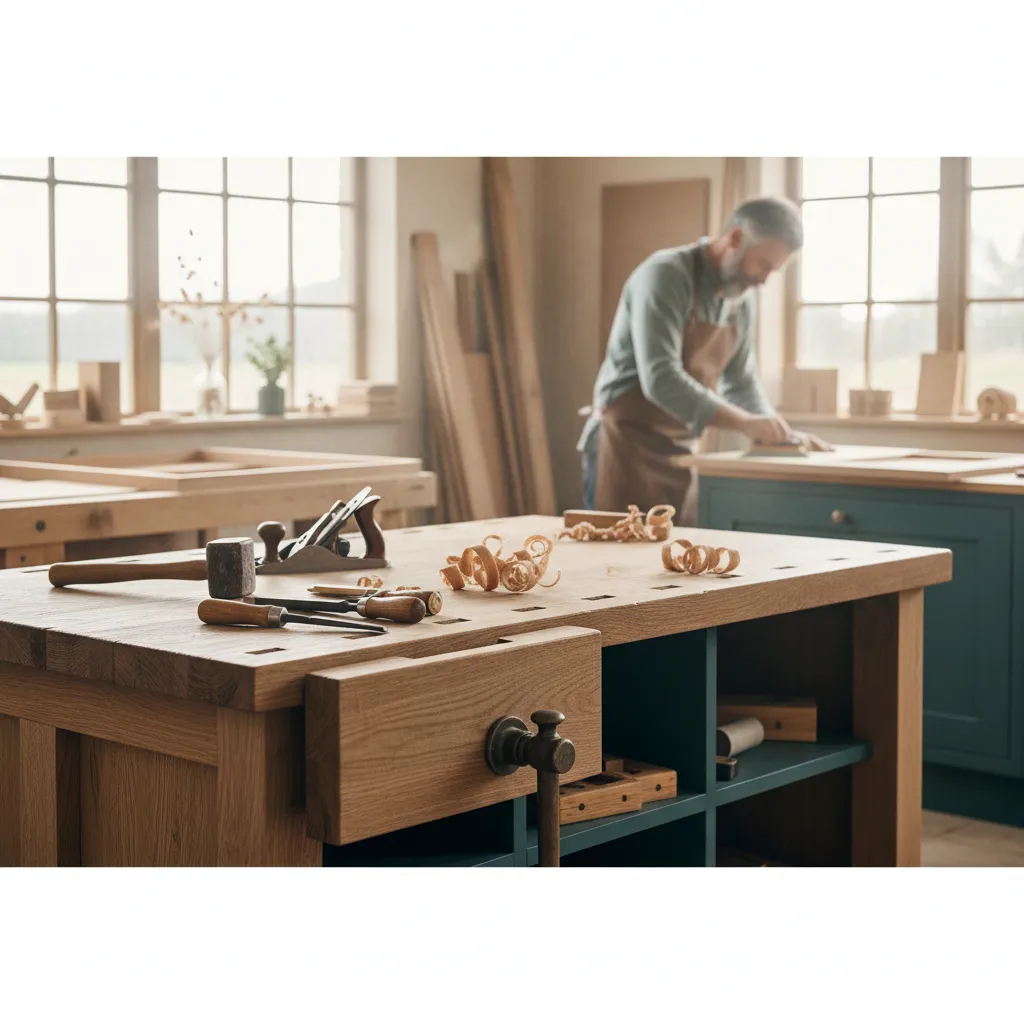
Choosing the best timber for handmade kitchen that won't warp comes down to species, cut, and how the wood was dried.
European Oak leads our Yorkshire workshop, with American Black Walnut, Mahogany, and Iroko close behind. Stability depends on dense grain, low moisture content, and joinery that lets the wood move without stressing the frame.
Warping begins when moisture enters or leaves the wood fibre unevenly. Dense, naturally oily hardwoods with tight grain resist that movement best. European Oak rates highest because tyloses block the pores, so water absorption is slow and the boards hold their shape year after year in a working kitchen.
American Black Walnut sits a close second. It is slightly softer than oak (around 1010 Janka versus oak's 1360) but moves less across humidity swings, which matters for wide cabinet doors and long drawer fronts.
For painted kitchens, choose Tulipwood or Poplar for the frame and a stable engineered panel for the centre. Open-grain oak shows through paint and is harder to finish to a flat surface.
Quarter-sawn boards, kiln drying and acclimatising stock
Quarter-sawn oak and walnut cost more per board foot, but the cut puts the growth rings at near 90° to the face. The annual rings then run vertically through the thickness, so the board swells and shrinks mostly in depth rather than across its width. That is the single biggest reason a quarter-sawn hardwood door keeps flat in a steamy Yorkshire kitchen where a plain-sawn equivalent cups within a season.
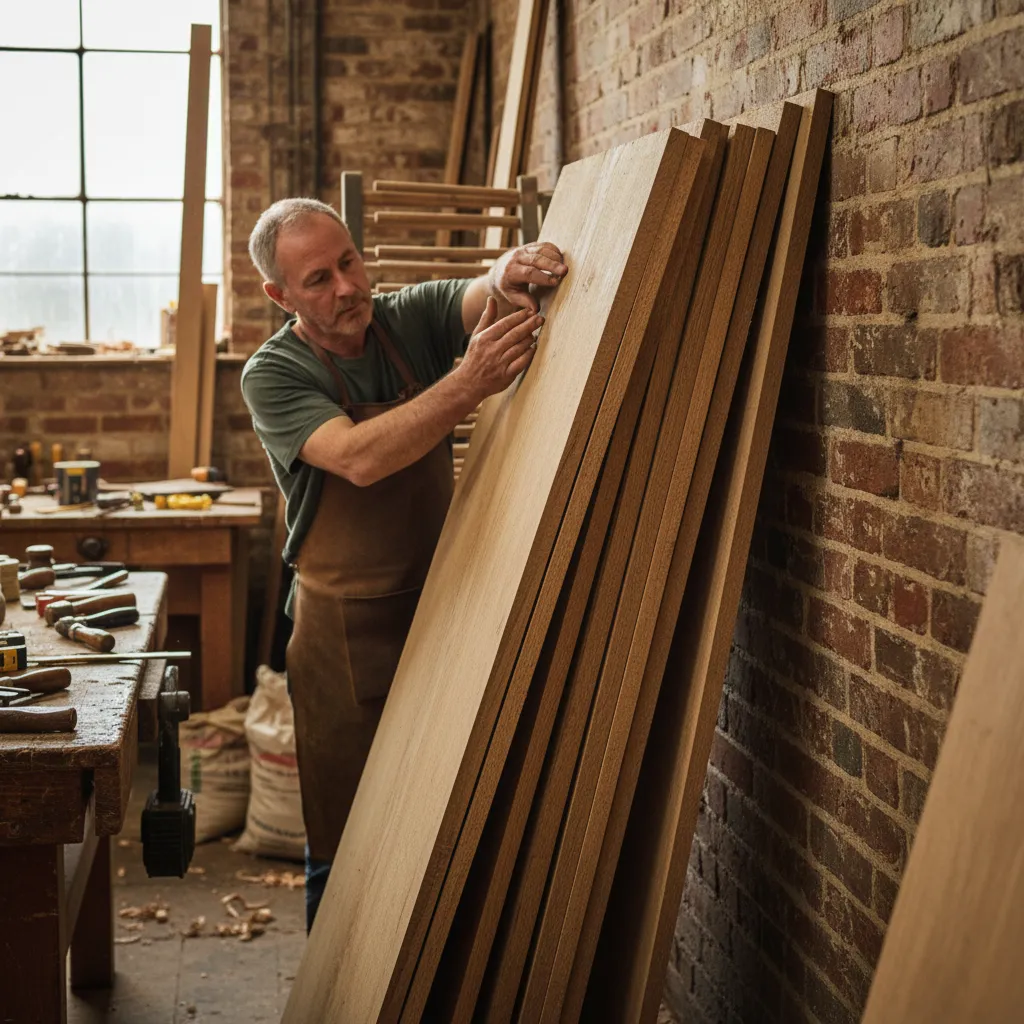
Moisture content matters as much as species. Timber arriving wetter than the room will dry out after install and move. Stock should come off the kiln at 8–10% MC for a UK kitchen, then rest in the workshop for two to four weeks before machining. A workshop that skips that step gets callbacks. Stack boards with thin slip spacers so air reaches all faces.
Solid timber, plywood and frame-and-panel construction
Solid hardwood performs best on frame-and-panel doors: a hardwood frame with a floating plywood or MDF panel. The frame absorbs seasonal movement while the panel is captured in a groove with room to slide. A solid timber panel wider than about 225 mm will move enough to crack a painted finish or split a frame.
For carcasses, Baltic birch plywood beats most solid boards because the cross-laminated veneers cancel each other's movement. Pair that with solid hardwood door frames and you get a wooden kitchen that sits flat for decades.
The trade-off is honesty about cost and weight. A full European Oak kitchen is heavy, and the price reflects quarter-sawn stock and longer lead times. Buyers who want a painted shaker kitchen on a tighter budget should pair a Tulipwood or Poplar frame with an engineered panel; the result still moves less than a solid timber panel would. Those who want a heritage oak kitchen should expect to wait for boards to acclimatise and accept the premium for quarter-sawn cut.
What wood is most resistant to warping?
European Oak is the most resistant hardwood we specify for handmade kitchens. Its closed grain and natural tannins slow moisture uptake, so cabinet doors stay true through the seasonal humidity swings common across the UK.
What type of wood warps the least?
American Black Walnut warps the least among the premium hardwoods we work with. Tight, straight grain and low movement coefficients mean a fitted walnut dresser in a Leeds townhouse keeps its panel alignment year after year.
What type of wood is most durable for cabinet doors that won't warp?
European Oak remains the most durable choice for cabinet doors in our experience, especially when quarter-sawn. A quarter-sawn oak door releases stress evenly across its face, which is why it outlasts plain-sawn alternatives on heritage shaker style kitchen projects across Yorkshire.
What type of wood expands the least?
Tulipwood expands the least across all the timbers we keep in our Yorkshire workshop. Tulipwood and Sycamore both show low tangential movement, making them reliable secondary choices where Ash or Pine would shift noticeably.
For tailored guidance on timber choice for your own project, send drawings or room photos to info@handmadekitchensyorkshire.co.uk or call 01484 666 333.
Talk Through Your Kitchen With the Workshop
What to bring to a design consultation
A rough sketch of the room with measurements of each wall, window, and doorway saves an hour of guesswork. Photographs of the space from three angles, plus examples of kitchens you have saved in a magazine or on a phone, give Daniel Fitzpatrick and the team a clear read on the style you want. A modern shaker kitchen can look very different from a heritage oak kitchen, so reference images save redesign time. Bring a list of must-haves (a dresser for crockery, a pull-out larder, a breakfast bar) and a list of what you cannot live with (no MDF carcasses, painted shaker only, reclaimed pine floor).
Samples of nearby flooring, worktops, or paint colours help the workshop match existing tones. If you have old joinery you want echoed, a photo of the moulding or panel shape speeds up the design. Painted kitchen units can be sampled in our finish room before sign-off, and shaker kitchen doors can be drawn full size for approval.
How to reach Oak & Pine by Design in Yorkshire
The workshop is based in Huddersfield, West Yorkshire, and visits are by appointment. Calls go to 01484 666 333, Monday to Friday, 9am to 5pm, and emails to info@handmadekitchensyorkshire.co.uk. A short note about your project, the rough budget, and your postcode is enough to start the conversation.
Site visits across the UK can be arranged once a design is in motion. Book a consultation through the contact page and the team will confirm a slot within two working days.
Sources
- Best Wood for Kitchen Cabinets: Choosing the Right Wood Type
- Understanding Wood Types: A Guide to Their Uses and Characteristics
- DIY Basics: wood for DIY projects - Lemon Thistle
- Making a cutting board that won't warp
- 12 Popular Kitchen Cabinet Materials - Pros & Cons - Laurysen Kitchens
- What type of hardwood Is good for Kitchen cabinets and ...
- A Craftsman's Survey of Timber Varieties and Their Roles in Building and Décor
- Top Choices for Timber That Stands Up to Moisture and Humidity