Quick answer: best timber for bespoke kitchen cabinets durability
European Oak and American White Oak lead the field for the best timber for bespoke kitchen cabinets durability, with Hard Maple and Walnut close behind.
At Oak & Pine by Design, our Yorkshire workshop has specified each of these species on commissions where families expect four decades of daily service from the same cabinetry.
What is the most durable wood for kitchen cabinets?
Hickory tops the commercial Janka scale for scratch and dent resistance, yet Hard Maple and American White Oak win for most UK kitchens because they pair density with stable machining and a finish that ages gracefully. In our Huddersfield workshop we have specified American White Oak for in-frame shaker doors on projects where families expect forty years of service from the same cabinetry.
What type of wood is best for kitchen cabinets?
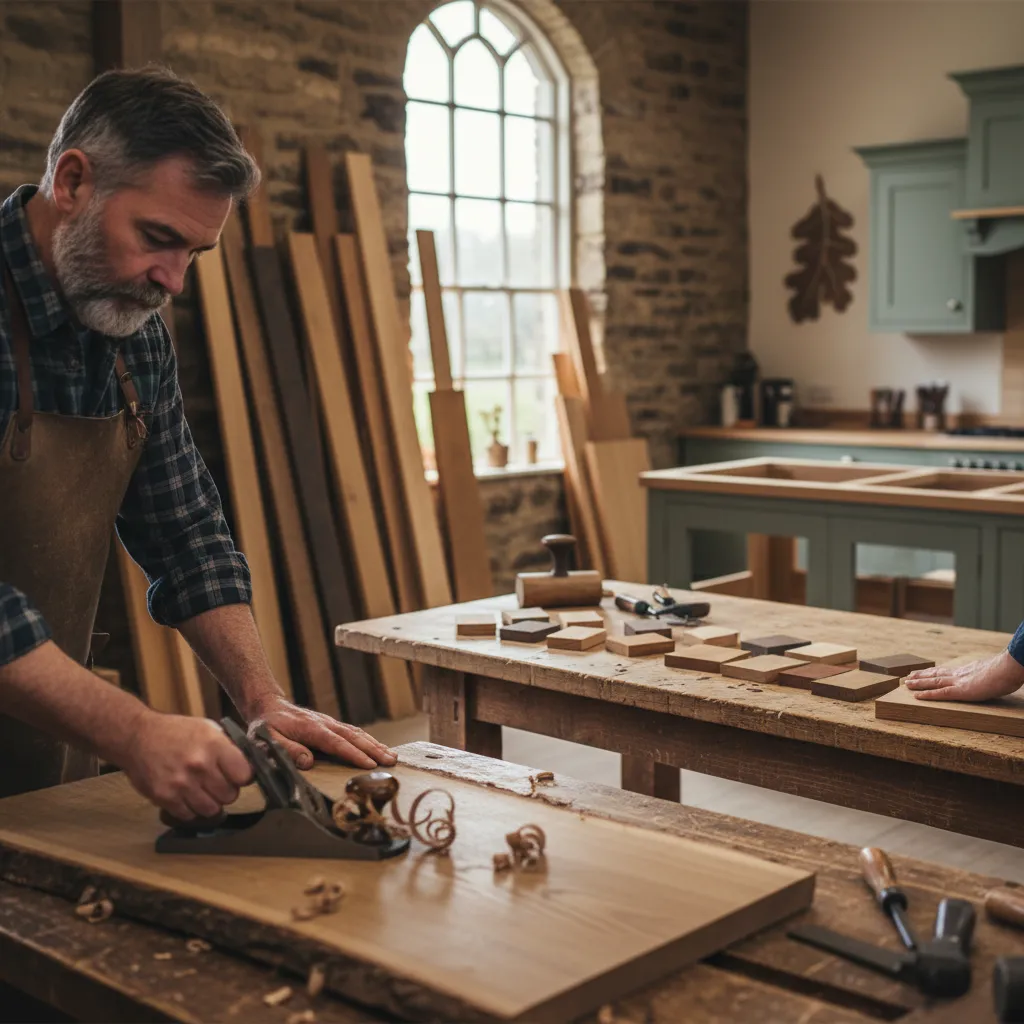
European Oak is the safest answer for solid timber doors, drawer fronts, and face frames in a busy British kitchen. It accepts hand-painting, oiling, and staining without raising the grain, and its tight cellular structure limits the seasonal movement that wrecks cheaper carcasses. For painted shaker runs we steer clients toward Hard Maple or Tulip Wood, both of which give a flatter surface for brush finishes on shaker style kitchen doors.
What kind of kitchen cabinets last the longest?
Cabinets built with solid hardwood faces, hardwood plywood panels, and traditional mortise-and-tenon joinery outlast MDF, flat-pack, or particleboard units by decades. A handmade carcass in Oak or Ash, glued and pinned rather than stapled, can serve three generations if the finish is refreshed every decade.
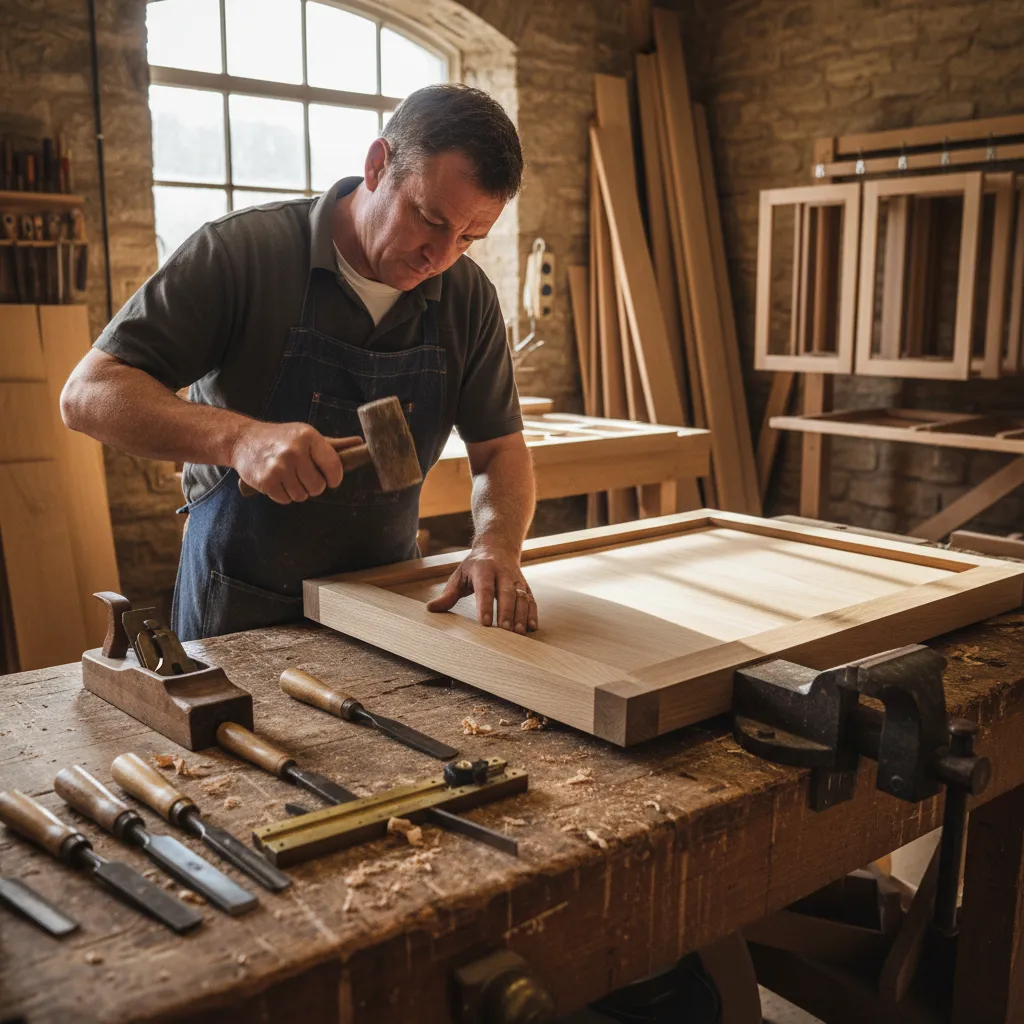
The trade-off is weight and cost: a full Oak kitchen runs roughly two to three times the price of an MDF equivalent, and the doors are heavier on the hinges. View timber samples in your own kitchen light before committing, and ask the workshop to confirm FSC or PEFC certification on the bill.
Janka hardness ratings for the cabinet timbers we work with
The Janka scale measures how much force it takes to embed a steel ball halfway into a timber sample. Higher numbers mean a denser wood that resists dents from pots, pans, and the corner of a stray grocery bag.
- European Oak and American White Oak: roughly 1,360 lbf
- Hard Maple: around 1,450 lbf
- Ash: about 1,320 lbf
- Walnut: near 1,010 lbf
- American Poplar / Tulip Wood: around 540 lbf
- Pine: roughly 420 lbf
For a family kitchen that sees daily knocks, Oak, Ash, or Hard Maple give you the headroom to take a hit without showing it. Poplar and Pine suit painted finishes where the timber is hidden under pigment and the surface takes abuse invisibly, which is why we lean on them for painted kitchen units.
Moisture and humidity resistance
British kitchens swing from a cold dry winter to a damp August, and a carcass that moves with the seasons will eventually crack at the joints. Oak, Ash, and Maple hold their dimensions well because their cell structure is tight and slow to absorb water. Tulip Wood and Poplar move more, which is why we reserve them for painted panels rather than structural frames.
Sycamore behaves like a denser Maple in our experience, machines cleanly, and takes oil finishes to a pale even tone. Walnut holds its shape but darkens quickly in sunlight, so we flag that with clients who want a uniform colour across a long run of doors.
Solid wood versus plywood versus MDF carcasses
Solid timber doors on an 18mm birch plywood carcass are the build we recommend most often. The plywood stays flat under heavy worktop loads, holds screws without stripping, and tolerates the odd plumbing leak far better than MDF kitchen cabinets. MDF suits painted doors and panels where you need a glass-smooth surface, but once the edge is breached the fibre swells and cannot be repaired the way solid Oak can.
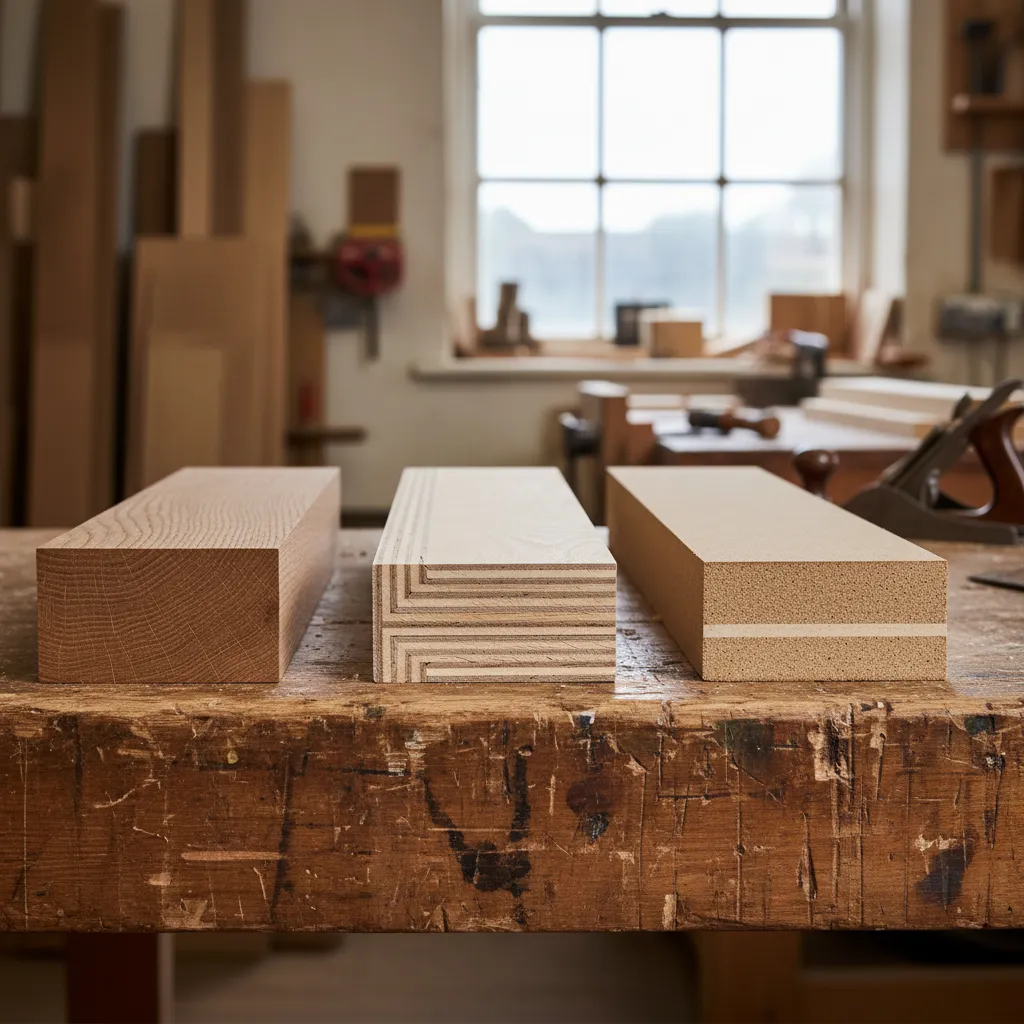
A practical rule from the workshop: use solid hardwood for doors, drawer fronts, and face frames; use birch plywood for carcasses and large panels; reserve MDF for painted panels that need a flawless finish and will not see standing water.
When to bring in the workshop
If your project involves an in-frame kitchen, a heritage refurbishment, or a room where off-the-shelf sizes will not work, the handmade kitchen service page sets out the materials, joinery methods, and lead times Daniel Fitzpatrick's team works to. Book a site visit through the contact page to get timber samples in your own light.
Frequently asked questions
What is the most durable wood for kitchen cabinets? European Oak is the most durable wood for kitchen cabinets in everyday UK homes, with a Janka rating of around 1,360 and a tight grain that resists denting at the corners and edges where doors take the most punishment.
What type of wood is best for kitchen cabinets? When choosing the right timber for kitchen cabinetry, hardwoods are the answer, with Oak, Ash, Maple, and Walnut standing out as the strongest contenders. Softer species such as Pine remain a sensible pick for painted shaker fronts, though in a hectic kitchen their knocks tend to surface sooner.
What kind of kitchen cabinets last the longest? Solid timber cabinets with hand-cut dovetail joints and a traditional hardwax oil finish last the longest, often 40+ years, because scratches can be sanded out and the surface re-oiled rather than replaced.
Which material is most durable for kitchen cabinets? For carcass construction, 18mm birch plywood is the most durable material because it holds screws without stripping and stays stable when humidity rises. Painted MDF suits doors and panels, though it will not survive a flood the way solid Oak will.
Speak with the workshop about your bespoke kitchen
Choosing timber for a bespoke kitchen is a decision you live with for decades, so the practical next step is a face-to-face conversation with the workshop. Bring your room measurements, a photo of your space, and any samples you have shortlisted. Daniel Fitzpatrick personally oversees every project from sketch to installation, and seeing the timber in your own light prevents costly second-guessing later.
Call 01484 666 333, email info@handmadekitchensyorkshire.co.uk, or visit the contact page to book a consultation. Quotes are free and carry no obligation to proceed.
Sources
- The Best Kitchen Cabinet Materials - Sustainable Kitchens
- Most Durable Wood For Kitchen Cabinets - Cabinet Now
- 7 Best Kitchen Cabinet Materials: Which One is Right for ...
- Best Wood for Kitchen Cabinets: Compare Durability, Cost & Style
- The Most Durable Kitchen Cabinet Materials Ranked (2026 ...)
- Choosing the right timber for cabinet construction and kitchen cabinet doors
- Top timbers for kitchen cabinetry, examined by a cabinetmaker
- A kitchen designer weighs ten cabinet wood species head to head