
Quick Answer
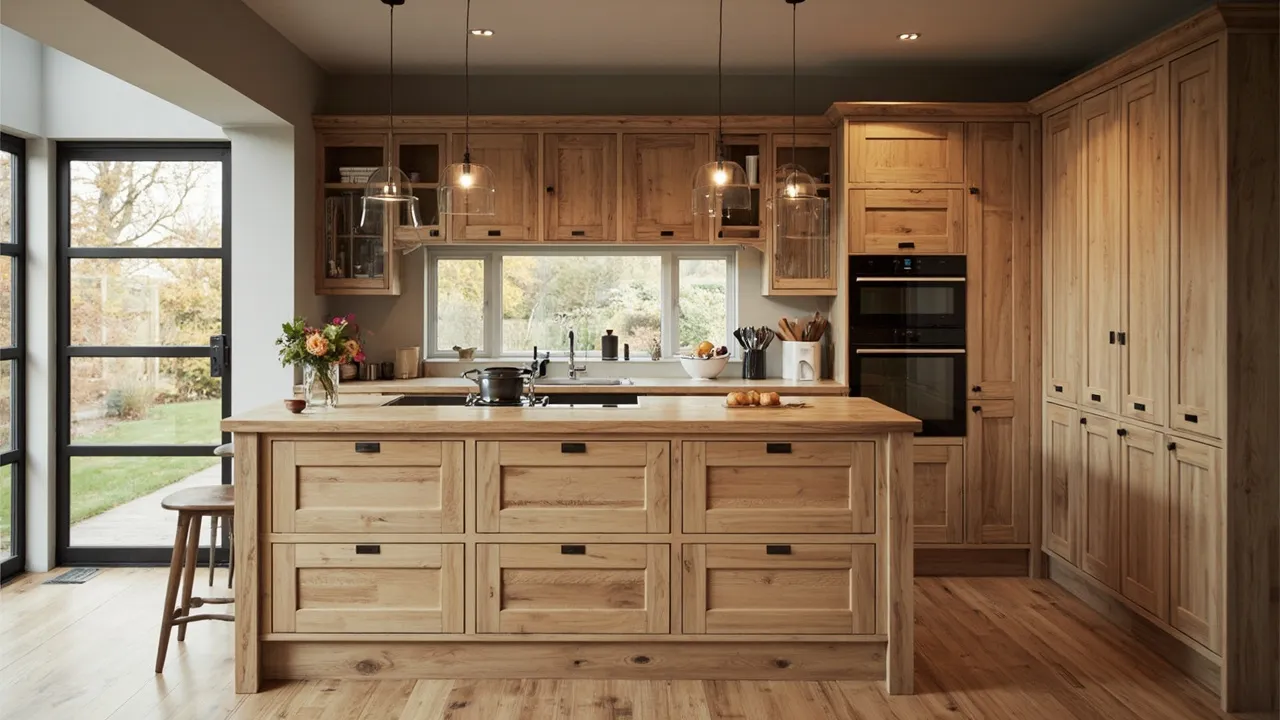
Bespoke oak kitchens are made-to-measure timber kitchens built room by room in a workshop, with solid oak doors, dovetailed drawers and a pale hardwax oil finish.
Expect a five-figure price, a matte surface you can re-oil in twenty years, and cabinetry drawn around your plan rather than picked from a brochure.

What Makes a Kitchen "Bespoke Oak"
The word "bespoke" gets used loosely, but in trade terms a bespoke oak kitchen is one where the cabinetry is drawn around a single room rather than selected from a price list. Doors, drawer fronts and carcases are cut from solid oak or oak-faced components, with every joint chosen at the bench: dovetails, mortise-and-tenon, hand-pinned. Beech, painted maple and birch ply each have their place in fitted furniture, yet oak is the timber most clients ask for, because it machines cleanly, takes a hardwax oil evenly, and can be sanded back decades later. A modular kitchen with an oak door on a chipboard carcase is not the same article as a cabinet dovetailed by hand in a small Honley workshop, and a fair comparison means asking how the carcase is built, how the drawers are joined, and whether the doors are solid timber or veneered. Those answers decide the price before the brochure does.
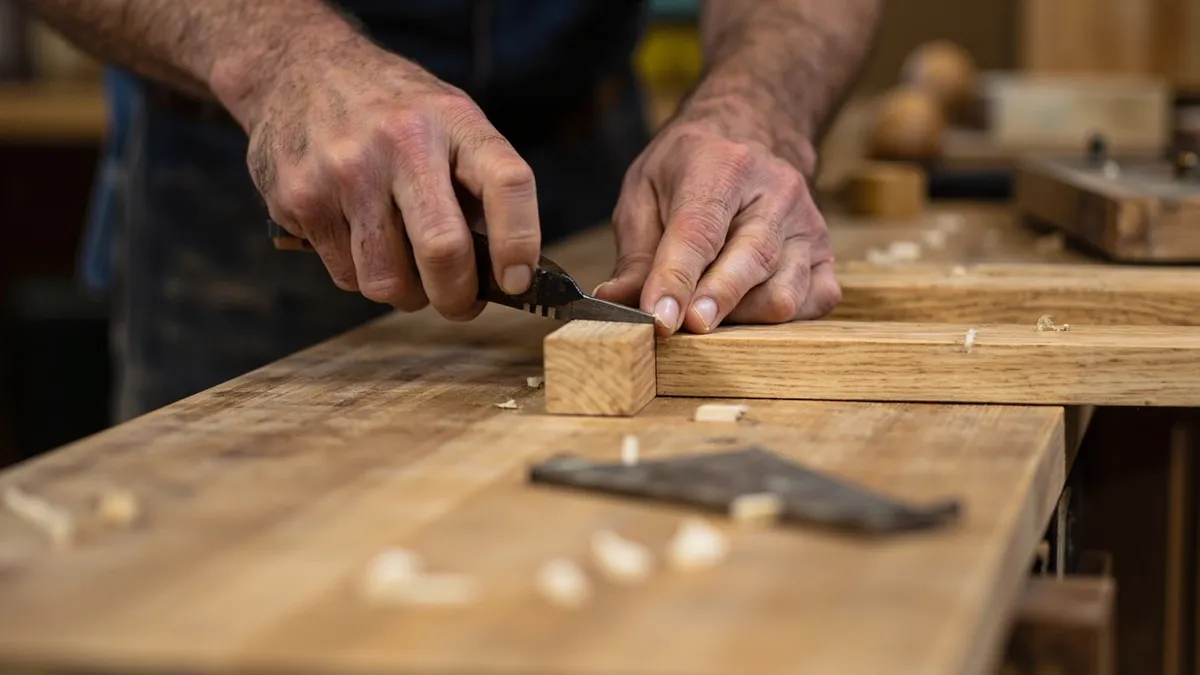
Oak & Pine by Design, the workshop behind these kitchens, uses oak as the default for precisely those reasons. The same cabinet finished in a wrapped foil or melamine cannot be repaired on site, only replaced. When we talk to homeowners weighing quotes against each other, the conversation almost always comes down to those three checks: carcase, drawer, door. Anything else is decoration.
Modern Oak Has Moved On From the 2000s Orange
Crown-cut, quarter-sawn and rift-sawn: how grain choice changes the look
The board you start with sets the mood of the whole room. Crown-cut oak shows the wide cathedral figure most people picture when they say the word, bold, busy, and the default on almost every oak dining set sold in the early 2000s. Quarter-sawn oak is cut at ninety degrees to the growth rings, which pulls the medullary rays into straight silvery flecks running across the board. Rift-sawn sits between the two, with a tighter, more linear grain and fewer flecks, and reads quieter against a painted run.
For a contemporary brief, most of the doors built at the Honley bench are quarter-sawn or rift-sawn. The cleaner figure takes a pale, brushed finish without shouting, and sits next to painted cabinetry instead of fighting it. Crown-cut still earns its place on a feature end panel, an island front, or a traditional in-frame door where the cathedral figure is the point. The working rule is simple: the busier the cut, the smaller the door it should sit on.
Why oils and hardwax finishes read nothing like old varnish
The orange tone that put a generation off oak came from the varnish, not the wood. A solvent varnish sits on top as a plastic skin, yellows within a few years, and locks the colour underneath. A hardwax oil soaks in, then hardens inside the fibres, leaving the surface open and matte. The grain reads close to its natural state, and the colour is held by pigment in the oil rather than by a film.
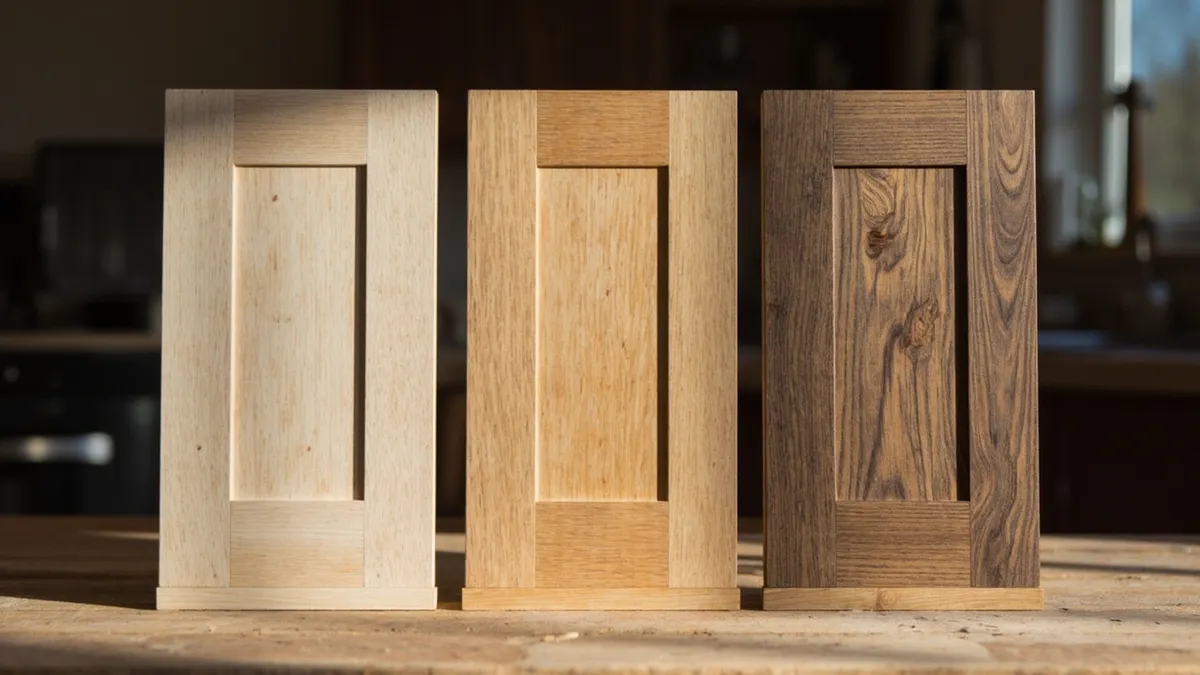
A clear hardwax on European oak reads as a soft, wheat-coloured honey. A white-pigmented hardwax pushes the yellow further back and gives the cool, limed look used in modern Scandinavian kitchens. A smoke or fumed oil deepens the timber towards the dark, near-walnut register of a French country kitchen. The same board, finished three ways, lands in three design worlds. If you remember 2000s oak and flinch, ask which finish is on a sample before you judge the wood; the offcuts on the bench in Honley tell the story in a way a photograph never quite manages. Bespoke oak kitchens finished in this way look nothing like the high-gloss oak of twenty years ago, and that is the single biggest shift in the market since the early 2010s.
Are Oak Kitchens Still in Style, and What They Look Like in 2026
Yes, oak kitchens are still in style, and the 2026 look has shifted away from the orange, glossy oak of the early 2000s. Today's preferred finishes are pale and matte, the grain is wider and quieter, and the doors are mostly flat or simple shaker rather than raised and moulded.
Pale Scandinavian oak, warm European oak and darker statement tones
Three colour families dominate current commissions. Pale Scandinavian oak, usually a whitewashed European oak with a clear matt hardwax, reads almost blonde and suits smaller Yorkshire terraces and new-build flats in Leeds. Warm European oak sits in the middle: a honey tone with visible medullary rays, finished in a natural oil that deepens over the first year. Darker statement tones, typically fumed or smoked oak, are reserved for islands and larder units, where a single deep surface anchors the room without crowding it.
Pairing oak with painted cabinetry and stone worktops
Oak works hardest when it is not everywhere. A common 2026 layout pairs a pale oak island with painted perimeter cabinetry in putty, soft green, or warm white, then grounds the run with a honed limestone or quartz worktop. The contrast is what makes the oak read as a considered choice rather than a default timber.
How Much Does a Bespoke Kitchen Cost in the UK?
The honest price bands and what really drives them
A fully fitted bespoke kitchen in the UK typically runs from around £25,000 to £80,000, with the most ambitious projects climbing past £100,000 once worktops, appliances and fitting are included, according to industry pricing published by the Kitchen Bathroom Bedroom Specialists Association (KBSA). Bespoke oak kitchens tend to sit in the middle to upper portion, because solid timber doors and hand-finishing cost more per square metre than factory-made alternatives. Treat any figure you read as a typical market range rather than an Oak & Pine quotation.
Five variables move the price more than any others: cabinet construction, door style, drawer boxes, worktop material, and how much hand-finishing the workshop carries out. An in-frame oak shaker with dovetailed oak drawers, a 30mm quartz worktop and hand-painted island will sit near the top of the band. Slab oak doors on frameless cabinets with a laminate worktop will sit much lower. Bespoke oak kitchens also attract a premium over painted birch ply because oak takes longer to machine, sand and finish by hand, and the offcuts cannot be used for smaller components in the way a sheet material can.
Where spending more genuinely buys you something
Three line items are worth paying up for. Solid oak dovetailed drawer boxes outlast any factory alternative by decades. A hand-applied hardwax oil penetrates the grain and can be re-coated at home, while a sprayed lacquer cannot be repaired invisibly by the owner. A fitter who scribes units to uneven walls makes the difference between a kitchen that looks built and one that looks dropped in.
Two items rarely justify the premium. Decorative end panels and matching pelmets are often charged as upgrades when standard sizes would do. Integrated handle rails look sleek but cost more than a simple brass knob and wear at the edges. When weighing quotes, ask for the cabinet, door and worktop lines broken out separately so you can compare like with like.
For a written quotation tailored to your room, book a showroom visit at the Honley workshop and bring your plan.
What Are the Oak Kitchen Trends for 2026?
What is coming through on the workshop floor this year
Bespoke oak kitchens in 2026 are moving away from heavy staining and toward lighter, more honest finishes that let the grain read clearly. Quarter-sawn European oak in a matt hardwax is the most common brief being drawn up at the bench, often paired with painted cabinetry in muted greens, warm whites, or stone grey. Slab doors in plain-sawn white oak sit comfortably next to a traditional in-frame shaker in the same room, and bronze or aged brass hardware is replacing polished chrome across nearly every specification we see.
Worktops are shifting with the doors. Customers who once asked for granite are choosing honed limestone, quartz composite, or full stave oak. Open shelving on solid oak brackets, rather than wall units, is appearing in more drawings, and freestanding oak dressers and islands are being specified alongside fitted runs rather than as an afterthought. Bespoke handmade kitchens in oak, finished this way, sit closer to joinery than to fitted furniture, and the overall tone for 2026 is calm rather than busy.
Finishes that will not look tired by 2035
The finishes that age well are the quiet ones. A natural matt hardwax oil, tinted only enough to warm the timber, will mellow rather than yellow. High-gloss lacquers and dark stains lock in a particular moment in fashion and are harder to repair when they scratch. A sample oiled onto an offcut and left on a sunny windowsill for a week is the simplest test of how a finish will read in ten years.
If you want a kitchen that still feels right in 2035, choose a timber you can re-oil rather than a surface you would have to strip and refinish. That choice is what separates a handmade kitchen from a modular one. Solid oak kitchen cabinets finished this way develop a softer, more even patina than any foil-wrapped alternative, which is why so many of the early-2010s replacements are being thrown out while original oak interiors are being kept and re-oiled.
Who Makes the Best Bespoke Kitchens, and What to Look For
The honest answer about who makes the best bespoke kitchens
The workshops that make the best bespoke kitchens are the small, owner-led ones where the same hands measure, build and fit your cabinets, rather than large showrooms that rebrand modular units as "bespoke". Ask four questions of any maker you are considering: who cuts the dovetails, who hand-sands the doors, who fits the kitchen on site, and how long have they been doing each of those jobs. Bespoke kitchens and furniture are essentially woodworking trades, and the answers sit in the workshop, not the brochure.
Construction, joinery and the small details that separate the best from the rest
A genuinely bespoke kitchen reveals itself at the drawer box and the back of the carcase. Look for dovetailed solid oak drawers rather than screw-and-glue boxes, butt hinges let into the door rather than clip-on concealed hinges, and 28mm cabinet end panels that take a hinge without a plate. Every drawer at the Honley bench is cut, glued and pinned by hand on English hardwood, and the same joiner who starts a kitchen usually finishes it. Ask any maker to send a photograph of a drawer removed and a cabinet back removed; the answer tells you more than any brochure. Guild of Master Craftsmen accreditation is one signal worth asking after, alongside references you can actually visit.
Design process, 3D visualisation and what a good consultation feels like
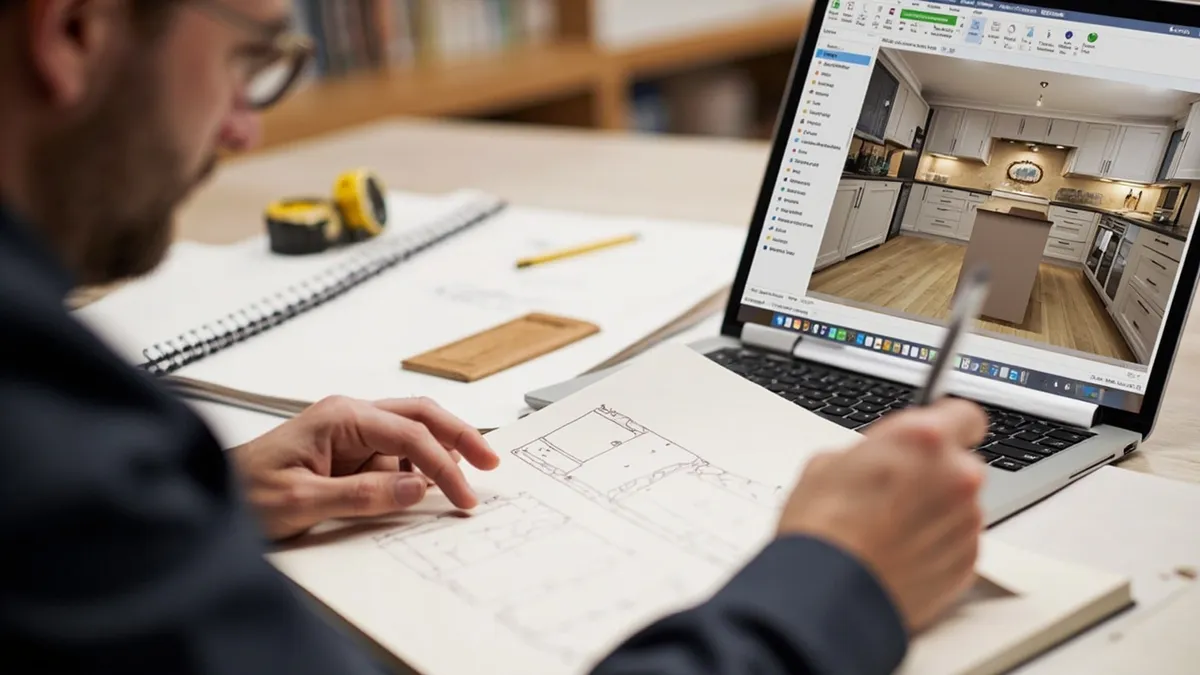
A good consultation feels unhurried, with a tape measure out and a sketchbook open. Your room is built in 3D from the survey, rendered in the oak finish you have chosen, and refined across door profiles, worktop junctions and lighting before a single board is cut. The drawing is the point: a 3D model lets you see that an 80mm increase in island depth changes the whole circulation of the room, in a way a flat plan never does. If a maker will not show you how your kitchen will look in your actual light, choose another.
Honest Trade-Offs and How Oak Behaves Over Time
Solid oak versus oak veneer on a stable core, and where each belongs
Solid oak is the right choice for face frames, door stiles and rails, drawer fronts and any component that takes knocks or wear, because it can be sanded and repaired decades later. Oak veneer on a stable, multi-layered core is the right choice for wide centre panels on shaker doors, tall larder doors, and full-height cabinet sides, because solid timber moves across its grain with seasonal humidity and a 600mm panel will cup, bow or split if it is one continuous piece. A workshop that uses both, and labels which is which on the quote, is being honest about how timber works. The same logic applies if you are weighing oak against a darker timber such as mahogany for a single feature panel. Best bespoke oak kitchens use solid timber on every component that wears, and only fall back to veneer where physics demands it.
Seasonal movement, ageing, and why a solid timber kitchen is still repairable in twenty years
Oak is hygroscopic. It expands in a damp August and contracts during a dry February once the central heating has run for a week, which is why every Oak & Pine kitchen is built with allowance for movement at every joint. Twenty years on, a scratched solid oak door can be sanded back, re-oiled and look new; a foil-wrapped or laminate door usually cannot, and the whole door is replaced. That repairability is one of the genuine, measurable differences between a handmade timber kitchen and a modular one.
Where oak is the wrong choice
If a high-gloss, handleless kitchen is what you want, oak is not it. A slab oak door finished in hardwax oil will never sit flush with the wall in the way a sprayed acrylic panel can, and the joinery shows. Saying so plainly makes every other claim in this article easier to believe.
Practical Care and What to Avoid
Wipe oak with a damp cloth and a drop of mild soap, then dry it. Never leave a wet cloth sitting on a worktop overnight; standing water leaves a white tide mark on hardwax that takes a light sand to remove. Keep the kettle and the coffee machine on a trivet, because repeated steam near solid oak will eventually raise the grain locally. A re-coat of hardwax every two to three years in the working zones, and every five elsewhere, keeps the finish even and the timber sealed.
Visiting the Honley Workshop and Booking a Showroom Visit
What you actually see and handle on a visit
The Honley workshop sits in a converted mill off the main road through the village, about ten minutes from Huddersfield and within easy reach of Holmfirth, Leeds and Wakefield. Visitors walk past the bench room first, where drawers are dovetailed and doors hung, before reaching the sample area.
On the bench you can pick up a finished oak drawer, feel the weight, and see how the grain runs through a solid door. Sample boards show European and American white oak, crown-cut and quarter-sawn, in hardwax oil, natural matt lacquer and aged stain. Handles, hinges and drawer runners are fixed to a board so you can test the soft-close action rather than guess from a catalogue.
How to book a showroom visit or design consultation
Visits are by appointment, usually lasting between one and two hours, so there is time to talk through your room and look at every sample. Bring a rough plan, a few photos and any inspiration you have saved, even on a phone.
To arrange a visit, call 01484 666 333 or email info@handmadekitchensyorkshire.co.uk, and a date will be confirmed personally within a working day. You can also book a showroom visit online at the workshop's contact page.
Frequently Asked Questions
How much does a bespoke kitchen cost?
A bespoke kitchen in the UK typically costs between £25,000 and £80,000 fully fitted, with larger projects rising past £100,000 once worktops, appliances and fitting are included. Bespoke oak kitchens tend to sit in the upper half of that band because solid timber doors and hand-finishing carry a real labour cost.
What are the oak kitchen trends for 2026?
The 2026 trends are pale and matte, with quarter-sawn European oak in a clear hardwax oil, shaker and slab doors used together, bronze or aged brass hardware, and stone or quartz worktops in honed finishes.
Who makes the best bespoke kitchens?
The best bespoke kitchens are made by small, owner-led workshops where the same hands measure, build and fit the cabinetry, such as Oak & Pine by Design in Honley, rather than large showrooms rebranding modular ranges.
Are oak kitchens still in style?
Yes, oak kitchens are still in style in 2026; the look has simply moved on from the orange varnish of the 2000s to pale, matte hardwax finishes and quieter grain. Bespoke oak kitchens finished this way are being specified by more Yorkshire homeowners now than at any point in the last decade, particularly across new-builds in Leeds and period homes in Wakefield.
Sources
- Kitchen Bathroom Bedroom Specialists Association – Consumer Information
- Oak | Bespoke Durable Oak Kitchens
- Bespoke Oak Furniture | Handmade Dining Tables & Kitchens | France & UK
- Oak 🤎 Few materials bring the same warmth and tactile ...
- Bespoke Oak kitchen cabinetry
See the work for yourself
Photographs only go so far with timber. The grain, the weight of a door and the feel of a drawer running true are things you have to handle. Every kitchen we make is built by hand in our Honley workshop, and you are welcome to come and see one being put together.
To talk through your kitchen or arrange a visit, book a showroom visit, call 01484 666 333 or email info@handmadekitchensyorkshire.co.uk.