
Traditional Joinery Techniques Bespoke Kitchen Guide
Why traditional joinery techniques matter in a bespoke kitchen
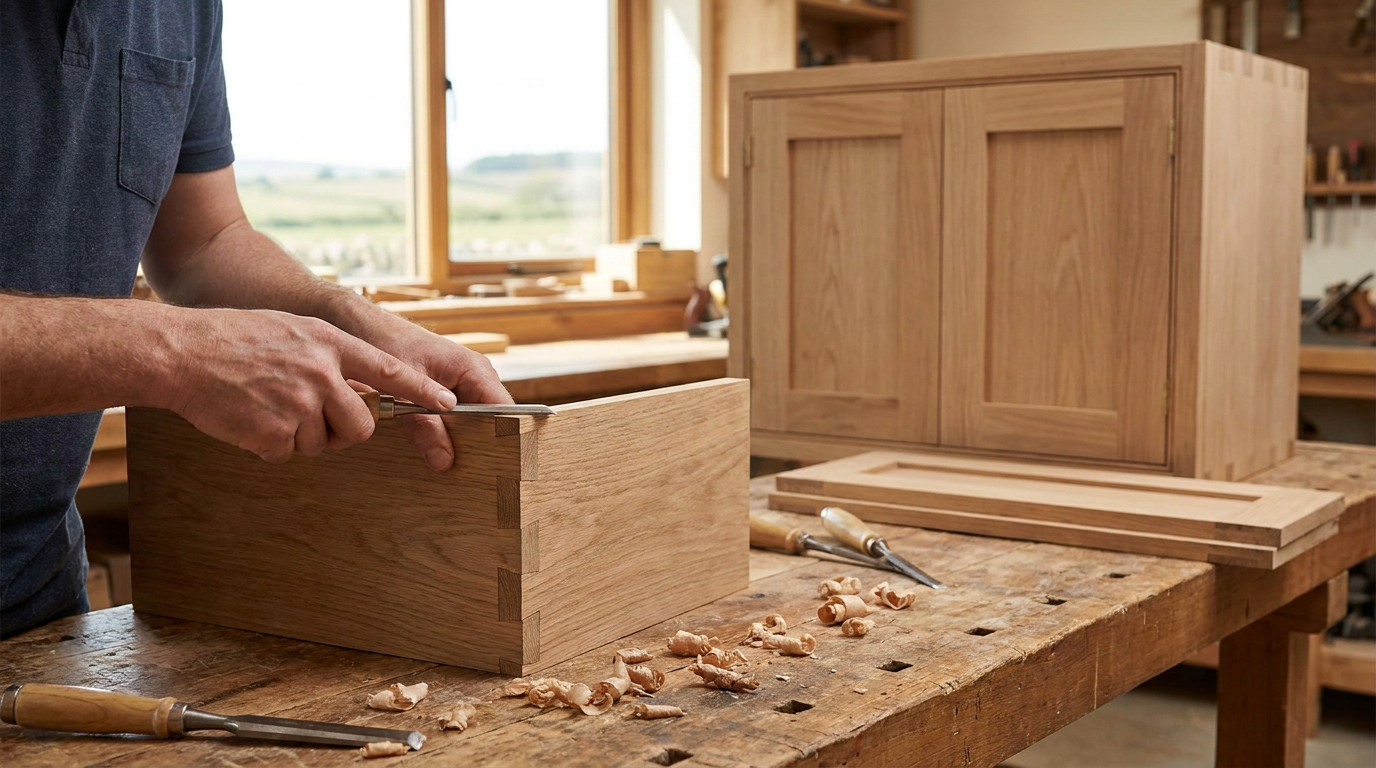
A kitchen built with traditional joinery techniques and a truly bespoke approach is designed to outlast trends, tenants, and decades. This is not a nostalgic choice. It is a structural one. At Oak & Pine by Design, every joint is cut and fitted in our Honley workshop by master craftsman Daniel Fitzpatrick, who has spent more than 25 years refining the methods that give solid timber its quiet strength. Here is what those methods involve, and why they justify the investment in a traditional joinery techniques bespoke kitchen.
What traditional joinery actually means
Traditional joinery connects timber using shaped interlocking cuts. It does not rely on nails, screws, staples, or glue alone. The two joints that appear most often in a quality bespoke kitchen are the mortise and tenon, used for face frames, door construction, and structural rails, and the dovetail, which appears on drawer boxes in three forms: through, half-blind, and sliding. A through dovetail is fully visible on the corner. A half-blind is hidden behind a drawer front. A sliding dovetail locks two solid boards together along a run.
Beyond the joints, traditional construction means in-frame cabinets where the door hangs within a solid wood frame. It means butt hinges or knife hinges that allow the wood to move seasonally. It means six-sided cabinet boxes with backs and tops cut from solid timber, not hardboard. It means drawers assembled, sanded, and fitted by hand so each one glides true. These are the hallmarks that define a traditional joinery techniques bespoke kitchen.
You can spot this craftsmanship without being a woodworker. Pull a drawer and look at the corners. Machine-cut joints are uniform and tight but lack the tiny variations of a hand-cut dovetail. Open a door and feel the hinge. A well-fitted traditional hinge closes with a soft, confident click, with no spring-loaded slam.
Why it outlasts flat-pack alternatives
Flat-pack kitchens rely on particleboard, cam locks, and confirmat screws. They are designed to be assembled in a few hours and replaced in a few years. A traditional joinery techniques bespoke kitchen is designed on a different timescale entirely.
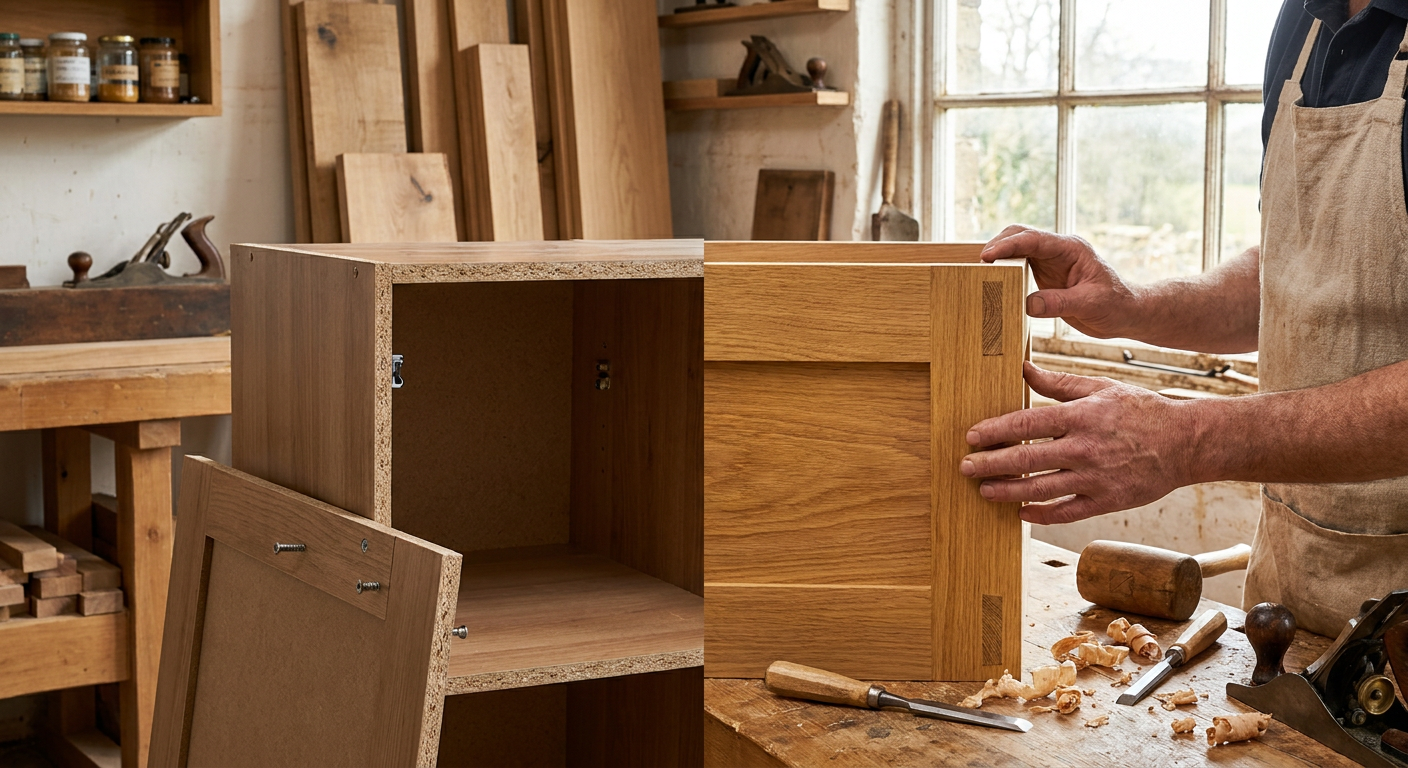
Mortise and tenon joints and dovetails work because the wood fibres are mechanically locked together. As the timber acclimatises to your home and settles under its own weight, those joints tighten. A cam lock loosens with every seasonal movement. A dovetail does the opposite. Museum pieces over two centuries old remain structurally sound without a single replacement fastener for the same reason.
Repairability is the second advantage. A damaged drawer side can be replaced by a skilled joiner in an afternoon. A blown particleboard panel usually means a new cabinet. The same applies to doors that drop, shelves that sag, or worktops that delaminate. With solid timber and traditional joinery, almost every component can be restored rather than discarded. That is the strongest sustainability argument a traditional joinery techniques bespoke kitchen can make.
For homeowners weighing budget against lifespan, the maths is straightforward. A bespoke kitchen from Oak & Pine by Design runs into several months from design to installation. It carries a higher upfront cost. In return, you receive a kitchen built to be repainted, refitted, and lived with for a generation.
Ready to see the difference in person? Visit the Honley showroom to inspect the drawer construction, feel the door action, and discuss your space with Daniel and the team.
Joints worth knowing: mortise and tenon, dovetails, and in-frame construction
The joints that signal a serious kitchen
Walk into our Honley showroom and the first thing an experienced eye checks is the joinery. Joints tell you everything about how a kitchen was built, how long it will last, and how much care went into it. Three techniques sit at the heart of our work: the mortise and tenon, the dovetail, and in-frame construction. Together, they define what a traditional joinery techniques bespoke kitchen should feel like: solid, quiet, and built to outlive its first owner.
You will not see screws, staples, or cam-and-dowel fixings on a properly joined cabinet. Instead, the timber itself does the work, locked together in ways that grow stronger as the wood settles over decades.
Mortise and tenon: the structural backbone
The mortise and tenon is the joint we reach for when a frame needs to carry weight. A square or rectangular peg (the tenon) is cut to fit precisely into a matching cavity (the mortise), then drawn tight with a wedge or glue. We use it for door frames, face frames, and the carcass rails that hold a tall larder together.
Cut by hand with a chisel and mallet, the fit is governed by eye and feel rather than a CNC tolerance sheet. The result is a joint that resists racking, holds a door square through years of opening, and can be repaired rather than replaced if it ever loosens.
Dovetails: where quality shows itself
Open a drawer and the jointing tells you who built it. Through dovetails, half-blind dovetails, and sliding dovetails are the marks of cabinetmaking done the traditional way. At Oak & Pine by Design, Daniel Fitzpatrick cuts drawer sides so the interlocking tails and pins are visible on the corners, a quiet signature that the drawer box was constructed as a single, solid unit rather than stapled together and hidden behind a face.
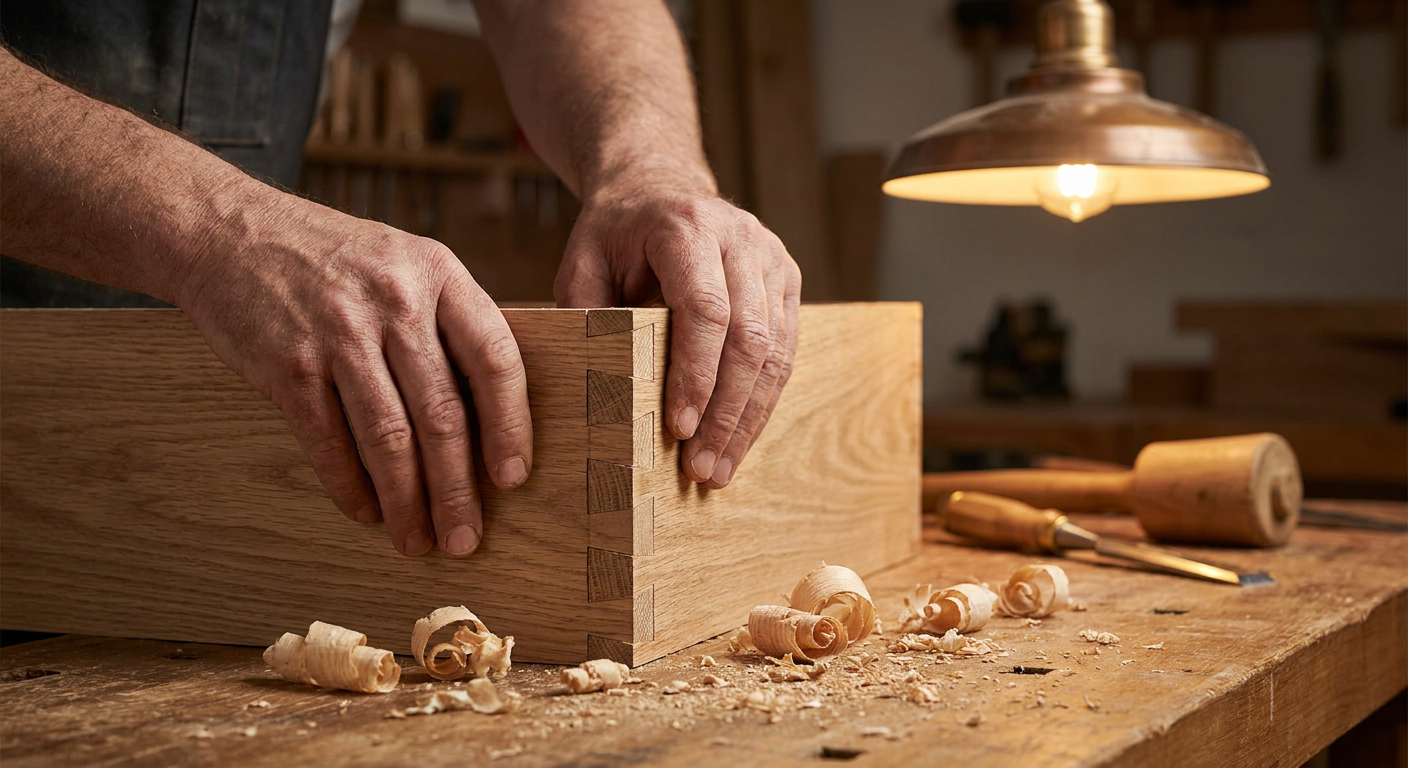
Dovetails matter because drawers take the worst punishment in any kitchen. Daily opening, loaded weight, and the occasional slam. A dovetailed drawer can be pulled, pushed, and filled for decades without working loose, and it is one of the clearest signals of a properly built traditional joinery techniques bespoke kitchen.
In-frame construction: the cabinet that stays true
In-frame kitchens build the cabinet around a fixed wooden frame, with doors and drawers mounted within that frame rather than directly onto the carcase. Traditional butt hinges seat into the timber, creating wood-to-wood contact that holds alignment through seasonal movement.
The practical benefit is straightforward. Doors stay square, gaps stay even, and the whole piece resists the dropping and warping that frustrates owners of flat-pack units. The aesthetic benefit is just as important, giving a bespoke kitchen the proportions and shadow lines that define Shaker and country designs.
Why it matters for your home
Traditional joints cost more in time. A dovetailed drawer might take three times longer to cut than a dowelled one. A fully framed cabinet demands more timber and more hours in the workshop. What you receive in return is a kitchen that can be repaired, repainted, and passed down, an investment measured in generations rather than years.
If you would like to see these joints in person, our Honley workshop and showroom is open by appointment, where Daniel can walk you through the construction of your own design.
From sustainably sourced timber to the Honley workshop: how the kitchen takes shape
Choosing a traditional joinery techniques bespoke kitchen is a decision that reaches well beyond surface style. Every cabinet, drawer, and door begins as a conversation about how you live, cook, and store. It then travels through a workshop where master craftsmanship shapes sustainably sourced solid timber into a kitchen designed to outlive trends.
Timber selection and preparation
Every kitchen starts with the wood itself. Oak & Pine by Design draws from eight timber ranges, including European oak, Canadian maple, mahogany, beech, painted finishes, reclaimed pine, and Shaker styles. Each is chosen for character, grain, and structural integrity. Reclaimed pine brings a patina that new timber cannot replicate. Oak and maple offer the density needed for doors and worktops that will see decades of daily use.
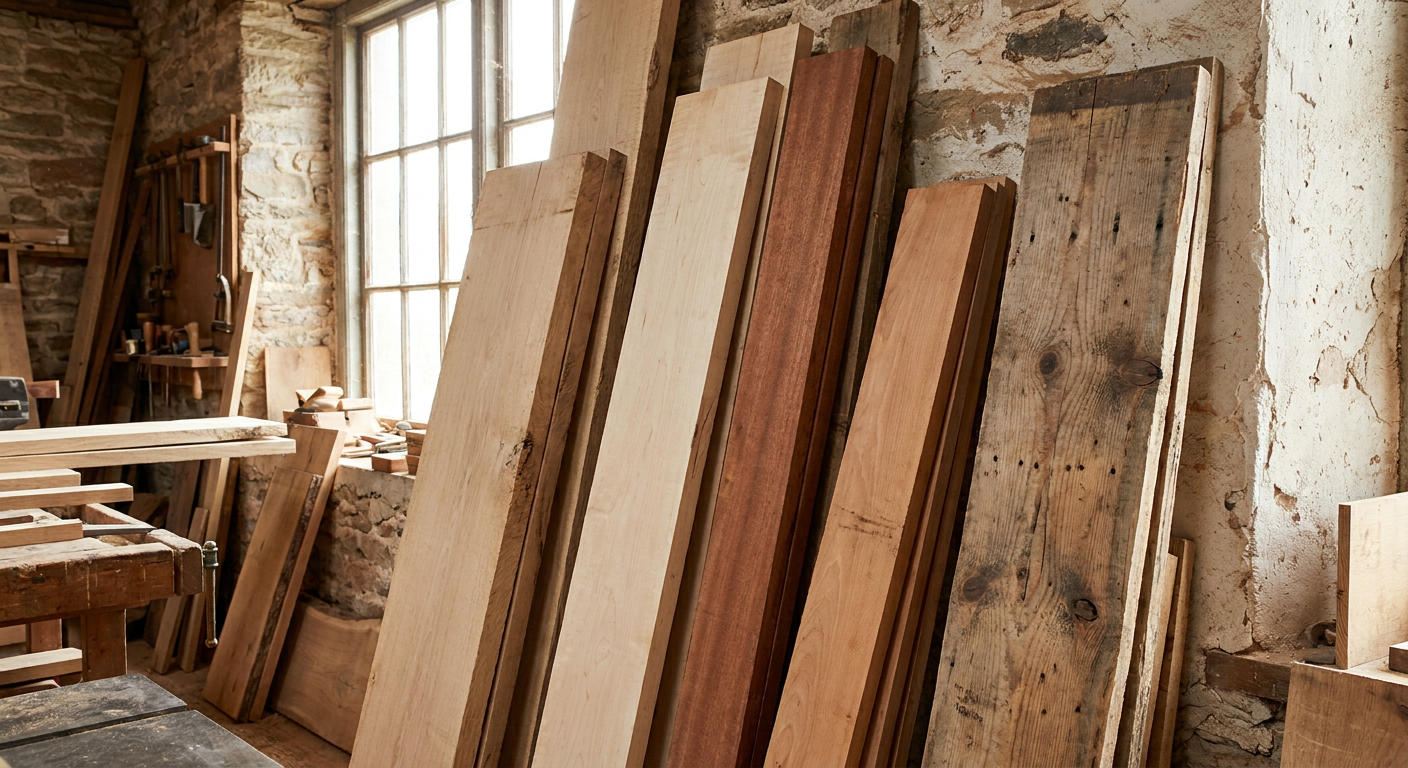
Daniel Fitzpatrick, founder and master craftsman, oversees timber selection personally. Boards are inspected for moisture content, movement, and defects before they enter the workshop. Properly seasoned timber is the foundation of any long-lasting piece. Poorly dried stock will twist, cup, or split regardless of how well it is jointed later.
Once approved, boards are acclimatised inside the Honley workshop, planed, and dimensioned by hand where needed. This preparation stage is unhurried by design. Traditional joinery work depends on joints that fit with hairline accuracy, and that accuracy begins with timber that is true, stable, and ready to be cut.
Hand-built in Yorkshire, overseen by the craftsman
All work takes place in the single Honley workshop, where Daniel and his team shape every kitchen from initial drawings through to final assembly. Guild of Master Craftsmen accreditation signals more than quality. It confirms that the same hands drawing the joint also cut, fit, and finish it. With more than 25 years of heritage joinery experience, Daniel remains the point of accountability on every project.
The construction methods reflect that philosophy. Mortise and tenon joints frame doors and carcasses. Through and half-blind dovetails lock drawer boxes together without a single screw. In-frame construction with traditional hinges creates solid wood-to-wood bonds that resist the warping and dropping common in flat-pack alternatives. Cabinets are built as fully solid, six-sided structures, including backs and tops, for maximum stability.
Subtle hand-cut variations, the slight asymmetry of a dovetail pin, are markers of authenticity rather than flaws. They confirm that a kitchen has been made, not assembled. The result is a legacy piece: a traditional joinery techniques bespoke kitchen built in Yorkshire, designed around your home, and engineered to serve your family for generations.
Ready to see the workshop in person? Visit the Honley showroom to discuss your project with Daniel and review timber samples across all eight ranges.
Customising your kitchen: styles, timbers, and the realities of a 10-week build
Matching the design to your home
A bespoke kitchen should feel like it has always belonged in your home. At Oak & Pine by Design, every project begins with a conversation in the Honley showroom, where master craftsman Daniel Fitzpatrick walks you through eight solid timber ranges: oak, pine, mahogany, maple, beech, painted finishes, reclaimed pine, and Shaker. Each timber behaves differently. Oak carries depth and weight. Pine softens with age. Reclaimed boards bring patina that cannot be manufactured. Choosing the right wood matters as much as choosing the layout, because it sets the tone your kitchen will carry for the next thirty years.
The next decision is style. A traditional joinery techniques bespoke kitchen draws on construction methods that pre-date mass production: mortise and tenon frames, hand-cut dovetail drawers, in-frame doors hung on traditional butt hinges. These joints are not decorative. They create solid wood-to-wood bonds that tighten as timber settles, resist warping in the damp British climate, and remain repairable decades later. A Shaker kitchen built this way feels restrained and architectural. A painted kitchen hides the joinery behind smooth runs of colour but keeps the structural integrity underneath.
Bespoke also means your room, not a standard template. Awkward chimney breasts, sloping ceilings, uneven Victorian walls, and unusual door positions become design opportunities rather than compromises. Storage is configured around how you cook, plate, and store: deep larder pull-outs, drawer banks sized for your pans, pantries that swallow a supermarket shop. Because every dimension is drawn from scratch in the workshop, the kitchen fits the architecture and the household, not the other way round.
Timeframes, installation, and aftercare
A handmade kitchen from a single Yorkshire workshop cannot be rushed. From design sign-off to handover, expect roughly 10 to 14 weeks, depending on complexity and finish schedule. Timber is acclimatised in the workshop for several weeks before machining, then hand-cut, assembled, sanded, and finished with hardwax oils or paint in multiple coats. Daniel personally oversees every stage, supported by a Guild of Master Craftsmen-accredited team.
Installation typically takes three to five working days for a full kitchen. Because units are built to the millimetre, on-site adjustments are minimal. Plasterers, electricians, and plumbers are scheduled around the fit, and the workshop coordinates the sequence to keep disruption in your home short. Surfaces, splashbacks, and final snagging follow within the same week.
Aftercare is straightforward but worth knowing. Wipe spills promptly, re-oil worktops annually with a recommended hardwax oil, and avoid placing cabinet doors in direct coastal sunlight for prolonged periods. Hinges and runners can be adjusted or replaced in minutes. Should a door get knocked, traditional joinery can be repaired in place rather than replaced, a quiet advantage of solid timber over flat-pack alternatives and a defining feature of any traditional joinery techniques bespoke kitchen.
Your next step is a showroom visit in Honley, where you can see joinery details up close, compare timber samples, and discuss your room with the workshop directly.
Choosing a traditional joinery techniques bespoke kitchen: what to ask your maker
A traditional joinery techniques bespoke kitchen represents a serious investment in craftsmanship. The difference between a good kitchen and a great one often lies in the questions you ask before commissioning. Because every maker works slightly differently, understanding what separates hand-cut joints from machine-cut ones helps you compare quotes, timelines, and quality on equal terms.
Start with the joints themselves
Ask which joints the maker uses in the parts of the kitchen that take the most stress: drawer boxes, door frames, and carcass corners. Dovetail joints on drawers remain the recognised sign of quality cabinetmaking, whether through, half-blind, or sliding. Mortise and tenon joints anchor door frames and structural elements, creating wood-to-wood bonds that tighten as timber settles over time. If a maker cannot tell you which joints appear where, that tells you something too.
It is worth asking whether joints are hand-cut, machine-assisted, or a blend. Both approaches can deliver excellent results, and the distinction is often philosophical as much as practical. Subtle hand-cut variations carry a quiet authenticity that machine production cannot replicate, and they remain the signature of a true traditional joinery techniques bespoke kitchen.
Ask about the timber and where it comes from
Traditional joinery depends on stable, well-seasoned timber. Ask which species your maker recommends for your space, how the wood is dried, and whether it carries certification from a recognised body. Oak, mahogany, and beech behave differently in a humid kitchen, and an experienced maker will explain why they have suggested a particular board for your project. Sourcing matters: timber from well-managed forests carries a chain of custody you can verify.
Understand construction beyond the cabinet fronts
Open a drawer and look at the back panel. Lift a corner unit and check the base. A genuinely solid kitchen uses six-sided construction, with backs, tops, and bottoms properly framed rather than stapled hardboard. In-frame construction with traditional hinges resists the warping and dropping that frustrates owners of cheaper units a decade in. These details rarely appear in glossy brochures, so ask directly.
Clarify the process, timeline, and what bespoke actually means
True bespoke begins with a measured survey and original drawings, not a catalogue of standard sizes. Expect ten to fourteen weeks from sign-off to installation for a fully bespoke kitchen, longer for complex layouts. Ask who will be in the workshop building your units, who fits them, and whether the person you meet at quotation is the person cutting the joints. At Oak & Pine by Design, master craftsman Daniel Fitzpatrick oversees every project that leaves the Honley workshop, backed by Guild of Master Craftsmen accreditation and over two decades of heritage joinery experience.
Finally, ask about care and longevity
A traditional joinery techniques bespoke kitchen should outlast its owner with sensible care. Ask for written guidance on cleaning products, humidity ranges, and which finishes can be refreshed in situ. A maker confident in their work will welcome the question, and you will leave the consultation knowing exactly what you are buying.
Sources
- Traditional Joinery Techniques for Modern Kitchens: Craftsmanship That Lasts
- The Making of a Kitchen: Inside Our Workshop | Harvey Jones
- What is Joinery Work in Construction | OPPEIN
- The Art of Joinery: Why Traditional Woodworking Techniques Matter in Modern Furniture - Frailey Woodworks
- The Benefits of Bespoke Joinery | KLC School of Design Blog
- A Guide to Wood Joinery: Types, Strengths & Techniques
- Traditional Woodworking Techniques and Why They Matter - Workshopshed
- Joinery Techniques: Mid-Century Craftsmanship Guide – Egg Culture